Understanding whether all heirs must agree to sell an inherited property in Texas requires navigating complex state laws, probate procedures, and family dynamics. Texas inheritance laws provide multiple pathways for property sales, depending on whether the estate has a will, how the executor was appointed, and whether heirs can reach consensus. The answers vary significantly based on factors like ownership structure, executor authority, and whether heirs disagree about selling. In this blog post, Texas probate real estate expert Dallas Seely discusses the legal requirements and practical options for selling inherited property in Texas when heirs disagree.
In Texas, all heirs generally must agree to sell an inherited property if they own it as tenants in common. However, significant exceptions exist. If the estate has an independent executor appointed under Texas Estates Code § 351-361, that executor typically can sell property without heir approval. Additionally, if heirs cannot reach agreement, any heir can file a partition lawsuit under Texas Property Code, forcing a court-ordered sale with proceeds divided among all heirs.
Key Takeaways
- All heirs must typically agree to sell an inherited Texas property when ownership passes as tenants in common, unless specific exceptions apply
- Independent executors in Texas (appointed under Texas Estates Code § 351-361) generally have legal authority to sell estate property without obtaining heir approval
- Partition lawsuits provide a legal remedy when heirs disagree—any heir can petition Texas courts to force a property sale, with proceeds divided according to ownership interests
- Multiple offers within 24 hours give families options to resolve disagreements with competitive pricing that may satisfy all parties’ interests
To Discuss Your Inherited Property Sale, Call or Text (512) 777-9530 Today for Multiple Offers Within 24 Hours.
Call Today To See How Much Your Inherited Property Is Worth – Sell Your Inherited Property Before Probate
Dallas Seely specializes in probate real estate throughout Texas, having guided hundreds of families through complex heir disagreements and property sales. With a probate attorney on staff, The Probate Realtor provides both legal guidance on partition lawsuits, independent executor powers, and affidavit of heirship procedures, combined with real estate expertise to maximize property value once legal pathways are established. This dual specialization makes The Probate Realtor uniquely qualified to help Texas families navigate both the legal requirements and the practical sales process.
Your Options for Selling Inherited Property in Texas
Do All Heirs Agree to Sell?
Is there a will?
Does will name an Independent Executor?
Executor Can Sell
Full Probate May Be Required
Affidavit of Heirship
Determination of Heirship
Is there an Independent Executor?
Executor May Have Power to Sell
Partition Lawsuit
Court Orders Sale
Proceeds Divided Among Heirs
Understanding Texas Inheritance Laws: Tenants in Common vs. Joint Ownership
The default ownership structure for inherited property in Texas determines whether unanimous heir agreement is required. Most inherited properties pass to heirs as “tenants in common,” meaning each heir owns an undivided fractional interest in the entire property. Consequently, this ownership structure creates the requirement for unanimous agreement because no single heir can sell the entire property or force others to sell without legal intervention.
What Does ‘Tenants in Common’ Mean in Texas?
When multiple people inherit property in Texas, they typically own it as “tenants in common.” This means each heir owns an undivided interest in the entire property—for example, if three siblings inherit, each owns 1/3 interest. Importantly, no single heir can sell the entire property or force others to sell without legal action. The probate process establishes these ownership interests based on the deceased person’s will or, if no will exists, according to Texas intestacy laws.
This ownership structure protects all heirs’ rights equally. However, it also creates challenges when heirs disagree about whether to sell. One heir cannot unilaterally list the property with a realtor or accept offers without the others’ consent. Therefore, any sale requires all co-owners to sign the deed transferring ownership to the buyer.
Community Property with Right of Survivorship (Alternative Ownership)
Some married couples own property as “community property with right of survivorship.” In these cases, the surviving spouse automatically inherits the entire property, bypassing probate and the heir agreement question entirely. This ownership structure is less common but represents an important exception to the general rule requiring heir agreement.
When property passes through right of survivorship, the surviving spouse becomes the sole owner immediately upon the other spouse’s death. As a result, no heir agreement is necessary because there are no other heirs with ownership interests. The surviving spouse can sell the property independently without consulting other family members.
Can an Executor Sell Property Without Beneficiaries Approving in Texas?
The executor’s authority to sell estate property without beneficiary approval depends entirely on how the will was written and whether the executor was appointed through independent or dependent administration. Texas law provides executors with varying levels of authority based on these factors.
What Is an Independent Executor?
An independent executor appointed under Texas Estates Code § 351-361 generally has the power to sell estate property without beneficiary approval or court supervision. This represents the most streamlined form of estate administration in Texas. The will must specifically grant independent executor powers, or all beneficiaries must agree to independent administration during the probate process.
Independent executors can make most estate decisions without court approval, including selling real estate. This authority significantly speeds the estate settlement process. Nevertheless, the executor still owes fiduciary duties to beneficiaries, meaning they must act in the estate’s best interests and cannot sell property for less than fair market value.
The Probate Realtor‘s probate attorney on staff can review your executor’s specific powers under the will to determine whether beneficiary consent is required for your particular situation.
Independent vs. Dependent Administration: Key Differences
Dependent administration requires court approval for major estate actions, including real estate sales. The executor must petition the probate court, provide notice to all beneficiaries, and obtain a court order before selling property. This process adds time and expense but provides additional oversight protecting beneficiaries’ interests.
The distinction between independent and dependent administration dramatically affects the timeline and complexity of selling inherited property. Independent executors can move forward quickly once appointed, while dependent administrators must navigate additional court procedures. Most Texas wills specifically provide for independent administration because it’s more efficient and less expensive.
“Many families are surprised to learn that Texas law gives independent executors broad authority to manage estate assets without court approval. However, this power comes with significant fiduciary responsibilities. The Probate Realtor works with executors to ensure they fulfill their legal obligations while maximizing property value for all beneficiaries.” – Dallas Seely
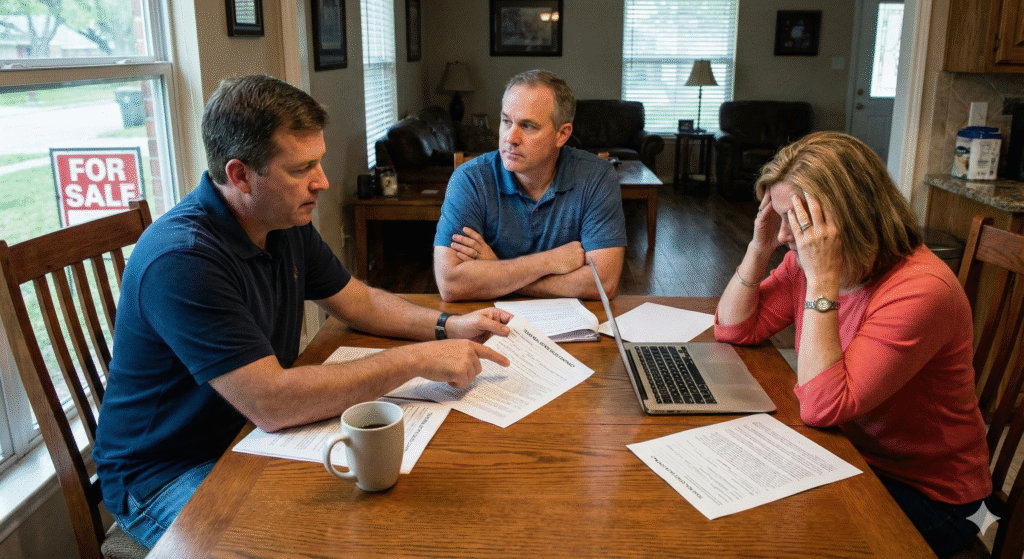
What Happens When One Heir Wants to Sell and Others Don’t?
When heirs disagree about selling an inherited property, Texas law provides legal mechanisms to resolve the deadlock. These options range from negotiation and buyouts to court-ordered partition lawsuits that force a sale regardless of unanimous agreement.
Option 1: Negotiation and Buyout Arrangements
The first approach involves one or more heirs buying out the others’ ownership interests. For example, if one sibling wants to keep the family home while two others want to sell, the sibling who wants to keep it can purchase the others’ shares at fair market value. This requires agreement on the property’s value and the buyout terms.
Buyout arrangements preserve family relationships better than litigation. Additionally, they allow the purchasing heir to keep the property while providing liquidity to heirs who want to sell. However, buyouts require financing capability and agreement on valuation, which isn’t always possible when emotions run high.
Option 2: Partition Lawsuit – Forcing a Sale Through Court
When negotiation fails, any heir can file a partition lawsuit under Texas Property Code to force a property sale. The court will order the property sold at public auction or through a court-appointed receiver, with proceeds divided among heirs according to their ownership percentages. This legal remedy ensures that no single heir can indefinitely block a sale against the wishes of co-owners.
Partition lawsuits represent the last resort when heirs fundamentally disagree. While they guarantee a resolution, they come with significant costs and timelines that reduce the net proceeds all heirs receive.
Understanding the Partition Lawsuit Process in Texas
The partition lawsuit process follows specific legal procedures established under Texas Property Code. Understanding these steps helps heirs make informed decisions about whether to pursue litigation or seek alternative resolutions.
Step 1: Filing the Partition Petition
Any co-owner can file a partition lawsuit in the county where the property is located. The petition identifies all co-owners, describes the property, and requests the court to order a partition. Texas law presumes that co-owners have a right to partition, meaning the court will typically grant the request unless special circumstances exist.
Filing fees vary by county but typically range from $200-$400. Furthermore, the petitioning heir must also hire an attorney, with fees ranging from $5,000-$15,000+ depending on case complexity and location. In Harris County (Houston), Dallas County, and other major metropolitan areas, attorney fees tend toward the higher end of this range.
Step 2: Property Appraisal and Court-Ordered Sale
The court appoints a commissioner to appraise the property and oversee the sale process. The commissioner determines fair market value and establishes a minimum bid price. Subsequently, the property is then offered for sale, either at public auction or through a private sale process approved by the court.
Court-ordered sales typically achieve lower prices than traditional market sales. Buyers at partition auctions receive property with clear title but may discount their offers due to the auction format and potential property condition issues. As a result, partition lawsuits often result in heirs receiving less than they would through a negotiated private sale.
Step 3: Proceeds Distribution
After the sale, the court distributes proceeds to co-owners according to their ownership percentages. The court first deducts sale costs, including attorney fees, court costs, and commissioner fees. These expenses can total 10-20% of the gross sale price, significantly reducing net proceeds to heirs.
How Long Does It Take to Sell an Inherited Property in Texas?
The timeline for selling inherited property in Texas varies dramatically based on the legal pathway chosen. When all heirs agree and proper legal authority exists, sales can occur relatively quickly. However, when partition lawsuits are necessary, the process extends significantly.
Timeline with Heir Agreement
When all heirs agree to sell, the process typically takes 60-120 days from decision to closing. This timeline assumes the executor has proper authority or all heirs are prepared to sign necessary documents. The process includes property preparation, marketing, accepting offers, and completing closing procedures.
The Probate Realtor‘s specialized approach accelerates this timeline significantly. With a network of pre-qualified buyers, Dallas Seely can present multiple offers within 24 hours. Heirs who need speed can close in as little as 2 weeks, eliminating months of traditional listing time.
Timeline Through Partition Lawsuit
Partition lawsuits extend the timeline to 6-18 months depending on county, court schedules, and case complexity. Harris County and Travis County typically move faster (8-10 months) due to more probate court resources. Meanwhile, rural Texas counties may take 12-18 months due to fewer court proceedings and less specialized attorney availability.
This extended timeline means carrying costs accumulate substantially. Property taxes, insurance, utilities, and maintenance expenses continue throughout the legal process, reducing the net proceeds eventually distributed to heirs.
What Is an Affidavit of Heirship in Texas?
An affidavit of heirship provides an alternative to full probate for some estates. This legal document establishes ownership when someone dies without a will and the estate consists primarily of real property with relatively low value. Understanding when affidavits of heirship are appropriate can save time and money.
When to Use an Affidavit of Heirship
Affidavits of heirship work best for small estates (generally under $75,000) with clear heirship. Two disinterested witnesses (people not related to the deceased or heirs) sign the affidavit attesting to the deceased person’s family structure and identifying all heirs. The document is then filed with the county clerk in the county where the property is located.
This process costs significantly less than full probate, typically $1,500-$3,500 in attorney fees plus minimal filing costs. However, it provides less legal certainty than court-supervised probate. Some title companies may require additional documentation or waiting periods before insuring title based solely on an affidavit of heirship.
Limitations of Affidavits of Heirship
Affidavits of heirship don’t work when heirs disagree about property disposition. All heirs must still agree to sell the property even after filing an affidavit. Therefore, if heir disagreement exists, an affidavit may establish ownership but won’t resolve the underlying conflict about whether to sell.
Affidavit of Heirship vs. Full Probate in Texas: Decision Guide
The Probate Realtor’s probate attorney on staff can evaluate your specific situation and recommend the most efficient legal pathway.
The Step-by-Step Process for Selling an Inherited Property in Texas After Legal Authority Is Established
Once legal questions about heir agreement and executor authority are resolved, the practical real estate sales process begins. The Probate Realtor specializes in guiding Texas families through this transition efficiently while maximizing property value.
Property Preparation and Valuation
Most inherited properties require some level of preparation before sale. Personal belongings may need removal, minor repairs might be necessary, and accurate valuation is essential. However, The Probate Realtor‘s approach eliminates many traditional preparation requirements.
The network of pre-qualified buyers purchases properties as-is, meaning no repairs, improvements, or staging are required. This saves executors and heirs thousands of dollars in upfront costs and eliminates months of preparation time. Properties can sell in their current condition regardless of deferred maintenance or outdated features.
Marketing and Offer Presentation
Traditional real estate listings require showings, open houses, and lengthy marketing periods. This approach creates inconvenience for executors managing properties and uncertainty about selling timelines. The Probate Realtor provides a fundamentally different approach.
Within 24 hours of providing property information, Dallas Seely presents multiple offers from serious buyers with proof of funds. These competing offers give heirs genuine choices about price and closing timeline. Some buyers offer higher prices with longer closing periods, while others provide immediate cash with 2-week closings. Consequently, heirs select the offer that best meets their specific needs.
Closing and Proceeds Distribution
Once heirs accept an offer, The Probate Realtor coordinates all closing logistics. Title companies prepare necessary documents, resolve any title issues, and facilitate the closing process. Closing can occur in as little as 2 weeks when families need speed, or on extended timelines if heirs prefer more time to coordinate.
After closing, proceeds are distributed according to each heir’s ownership percentage. If the estate has debts, the executor uses sale proceeds to pay creditors before distributing remaining funds to beneficiaries. The Probate Realtor‘s probate attorney on staff provides guidance on proper distribution procedures ensuring executors fulfill their legal obligations.
“The families I work with often feel overwhelmed by both the legal complexity and the practical challenges of selling inherited property. Having a probate attorney on staff means we can answer legal questions immediately while moving forward with the real estate transaction. This integrated approach saves families months of time and thousands of dollars in duplicated professional fees.” – Dallas Seely
Why Choose Dallas Seely to Sell Your Inherited Property in Texas
When heirs disagree about selling an inherited property or executors need to move quickly, working with a specialized probate real estate expert makes all the difference. Dallas Seely founded The Probate Realtor specifically to serve Texas families facing these unique challenges.

With over $700 million in career sales and ranking in the top 0.1% of agents nationwide, Dallas brings proven expertise to every transaction. More importantly, he understands the emotional and legal complexity families navigate during estate settlement. Having a probate attorney on staff sets The Probate Realtor apart from traditional real estate agents who lack legal resources to guide clients through partition lawsuits, executor authority questions, and heir rights issues.
The specialized approach eliminates traditional real estate hassles. No repairs or improvements are needed—buyers purchase properties as-is in any condition. Multiple offers within 24 hours provide certainty and negotiating power. Closing timelines as short as 2 weeks accommodate families who need immediate estate settlement. Additionally, cash advance options are available for families facing financial pressure during the probate process.
To discuss your inherited property situation and explore your options, call or text (512) 777-9530 today. Whether you’re dealing with heir disagreements, executor authority questions, or simply need to sell quickly, The Probate Realtor provides both the legal guidance and real estate expertise Texas families need.
Learn more about Dallas Seely and his commitment to serving Texas families through difficult transitions.
Serving Texas Families Throughout the State
While this guide addresses statewide Texas inheritance laws, The Probate Realtor serves executors and heirs throughout the state. Dallas Seely understands that probate properties can be located anywhere in Texas, and families often live far from the inherited home. Distance shouldn’t complicate an already difficult process.
The Probate Realtor provides specialized probate real estate services in all major Texas markets, including Austin, Dallas, Fort Worth, Houston, and San Antonio. Each market has unique characteristics, and Dallas Seely’s experience across Texas ensures you receive guidance specific to your property’s location.
Whether your inherited property is in a major metropolitan area or a smaller Texas community, The Probate Realtor can help. With remote consultation capabilities and a network of buyers throughout the state, distance is never a barrier to getting multiple offers quickly. Having a probate attorney on staff means Texas families receive both real estate and legal guidance regardless of where the property is located.
Follow Us on Social Media
Follow Dallas Seely and The Probate Realtor on social media for Texas probate real estate insights, inherited property tips, and market updates. Connect with us on X (Twitter) and Instagram for expert guidance.
FAQ
Yes, one heir can force the sale of an inherited property in Texas through a partition lawsuit filed under Texas Property Code. When property is owned as tenants in common (the typical inheritance structure), any co-owner has the legal right to petition the court for partition. The court will order the property sold, typically at public auction or through a court-appointed receiver, with proceeds divided among all heirs according to their ownership percentages. However, partition lawsuits come with significant costs and extended timelines.
Attorney fees typically range from $5,000-$15,000+ depending on location and complexity, and the process takes 6-18 months in most Texas counties. Court-ordered sales often achieve lower prices than negotiated private sales, reducing net proceeds to all heirs. Before pursuing partition, heirs should explore negotiation, buyout arrangements, or working with a specialized probate realtor like The Probate Realtor who can present multiple competitive offers that may satisfy all parties’ interests.
Ready to Move Forward? Let’s Talk About Your Inherited Property
Navigating heir disagreements and Texas inheritance laws doesn’t have to be overwhelming. Having the right guidance makes all the difference. Whether you’ve just learned about heir disagreement challenges or you’re ready to move forward with selling, The Probate Realtor is here to help.
Why Families Trust Dallas Seely with Their Probate Real Estate
Dallas Seely founded The Probate Realtor to help Texas families through challenging transitions. He brings both expertise and empathy to every probate situation. Most importantly, he has a proven track record of results.
Proven Track Record:
- Over $700M in career sales
- Top 0.1% of agents nationwide
- Top 3 real estate professional in Texas
- Top 10 in Central Texas
- 300+ families served annually
These aren’t just numbers. They represent hundreds of families who’ve successfully navigated probate real estate sales. Many did so during the most difficult times of their lives.
A Different Approach to Probate Real Estate
Most real estate agents treat inherited properties like standard listings. However, Dallas understands the unique pressures executors and heirs face.
Time-sensitive decisions create stress. Family dynamics add complexity. Property maintenance costs pile up. The weight of responsibility feels heavy. Because of these challenges, you need a specialized approach.
That’s why Dallas developed a streamlined process. It eliminates the traditional hassles:
- No repairs or improvements needed. You can sell the property as-is.
- No lengthy listing periods. Move forward on your timeline.
- No showings or open houses. Avoid the disruption and stress.
- Multiple offers within 24 hours. Compare options and choose what works best.
This isn’t about pushing a quick sale. Instead, it’s about giving you real options. You’ll get the information you need to make confident decisions during an uncertain time.
Comprehensive Support Beyond the Sale
The Probate Realtor offers more than just real estate services. We provide complete support throughout the entire process.
Full-Service Property Management:
Managing an inherited property from a distance can be overwhelming. Therefore, we handle everything you need:
- Property clean-outs and estate sales. We coordinate professional services to clear the home.
- Vendor orchestration. We connect you with trusted contractors for any needed services.
- Regular property checks. Weekly inspections ensure the home stays secure.
- Title clearing and coordination. We work with title companies to resolve any issues.
Executor Support and Guidance:
As an executor or heir, you’re navigating unfamiliar territory. We provide hands-on coaching throughout the real estate aspects of probate:
- Clear explanations of each step in the process
- Coordination with estate attorneys and other professionals
- Guidance on timing and decision-making
- Support with family communication about the property
Legal Guidance from Probate Attorney on Staff:
Questions about probate procedures don’t wait for business hours. That’s why The Probate Realtor has a probate attorney on staff. This unique resource means you get both real estate expertise and legal guidance in one place. Whether you need clarification on court requirements, executor responsibilities, or heir rights, you have direct access to legal counsel.
Guaranteed Responsiveness:
Questions don’t wait for business hours. That’s why we guarantee a response within 24 hours. This commitment sets us apart in an industry where responsiveness is often lacking. Your questions are always welcome. Your concerns are always addressed promptly.
Statewide Texas Expertise with Remote Convenience
Dallas serves families throughout the entire state of Texas. He has a deep understanding of Texas probate procedures. Additionally, he knows local market conditions across all regions. He also understands the unique challenges of inherited property sales.
Primary Markets Served:
- Austin
- Dallas
- Fort Worth
- Houston
- San Antonio
Your inherited property might be in a major metropolitan area. Or it might be in a smaller community anywhere across the state. Either way, Dallas has the expertise and network to help you achieve the best possible outcome.
Virtual Consultations Available:
Many heirs and executors don’t live near the inherited property. Therefore, we offer complete remote services. You can handle everything virtually if needed:
- Initial consultations via video call
- Electronic document signing where permitted
- Regular updates via your preferred communication method
- Never need to visit the property if you choose not to
This flexibility means you can move forward regardless of where you live. Distance doesn’t have to slow down the process.
How Quickly Can You Move Forward?
Speed matters when you’re managing an estate. Here’s what you can expect:
Within 24 Hours:
- Multiple offers on your property
- Initial consultation scheduled
- Questions answered
Within 2-3 Weeks:
- Property sold and closed (if you choose this timeline)
- Funds distributed according to estate requirements
- Property responsibilities lifted from your shoulders
Throughout the Process:
- Regular communication and updates
- Coordination with all necessary parties
- Support every step of the way
Get Started Today
Every day spent worrying about an inherited property is a day you don’t get back. Let’s start a conversation about your situation. There’s no pressure and no obligation. Just honest guidance and real solutions.
Get Multiple Offers in 24 Hours
Text “Probate” to (512) 777-9530
Or Schedule a Free Consultation
Call (512) 777-9530 to speak directly with Dallas
Email: [email protected]
The probate process can feel heavy. But you don’t have to carry it alone. Dallas Seely brings decades of experience and proven results. He’s committed to serving families with compassion and integrity. Because of this, he’s the trusted partner you need during this transition.
Serving families across Texas through life’s hardest transitions.