Inheriting property in Texas creates immediate questions about tax liability that executors and heirs need answered before making any sale decisions. Understanding capital gains tax rules prevents costly surprises and helps families maximize the estate value they ultimately receive. Texas’s lack of state income tax simplifies some calculations, but federal capital gains rules combined with county-specific probate procedures create complexity that requires specialized guidance. In this blog post, Texas probate real estate expert Dallas Seely discusses whether you pay capital gains tax when selling inherited property in Texas and how strategic sale planning minimizes tax exposure.
Most heirs in Texas pay little to no capital gains tax when selling inherited property due to the “stepped-up basis” rule. This federal provision resets the property’s cost basis to fair market value at the date of death, eliminating decades of appreciation from tax calculations. You only owe capital gains tax on value increases between inheritance and sale—often minimal if you sell within a year or two. Texas’s lack of state capital gains tax further reduces liability compared to other states.
Key Takeaways
- Stepped-up basis eliminates most tax liability: Property resets to fair market value at death, erasing prior appreciation
- Only post-inheritance gains are taxable: You pay federal capital gains tax only on value increases after inheriting
- Texas has no state capital gains tax: Unlike California or New York, Texas residents face federal obligations only
- Selling costs reduce taxable gains: Realtor commissions, title insurance, and pre-sale repairs are fully deductible
To Discuss Your Inherited Property Sale, Call or Text (512) 777-9530 Today for Multiple Offers Within 24 Hours.
Call Today To See How Much Your Inherited Property Is Worth – Sell Your Inherited Property Before Probate
Dallas Seely specializes in inherited property sales throughout Texas, having guided hundreds of executors through the intersection of probate procedures and capital gains tax planning. With over $700 million in career sales and a probate attorney on staff, The Probate Realtor provides both real estate expertise and legal guidance. Dallas’s experience navigating Travis, Harris, Dallas, and Bexar County probate courts ensures accurate property valuations that establish tax-advantaged stepped-up basis figures.
Inherited Property Tax Liability: What Texas Heirs Actually Pay
- 0% for income up to $94,050 (married)
- 15% for income up to $583,750 (married)
- 20% for income above those thresholds
Understanding Stepped-Up Basis: How Texas Inherited Property Gets a Fresh Tax Start
The stepped-up basis rule represents the single most important tax advantage for heirs selling inherited property. This federal provision under Internal Revenue Code Section 1014 resets the property’s cost basis to its fair market value on the date of the original owner’s death. The impact is dramatic: decades of property appreciation disappear from tax calculations entirely.
Consider a typical Austin scenario. A property purchased in 1995 for $125,000 appreciates to $575,000 by the owner’s death in 2024. Under normal circumstances, selling would trigger capital gains tax on $450,000 of appreciation. With stepped-up basis, the heir’s tax basis becomes $575,000—the date-of-death value. The $450,000 in appreciation that occurred during the original owner’s lifetime is never taxed.
How Stepped-Up Basis Eliminates Decades of Capital Gains
This tax treatment differs dramatically from receiving property as a gift. Gifted property carries over the original owner’s basis. You inherit their entire tax liability. Inherited property gives you a fresh start at current market value.
Timing matters significantly. The stepped-up basis applies at the date of death, not when you receive the property after probate closes. Texas probate typically takes six to nine months for independent administration, but your basis locks in at the death date. Market appreciation during probate creates your only potential capital gains exposure.
Establishing Fair Market Value: The Realtor’s CMA as Tax Documentation
Accurate valuation at the date of death determines your stepped-up basis and future tax liability. The Probate Realtor creates detailed retrospective Comparative Market Analysis reports that document fair market value using actual comparable sales from the death date period. These CMAs satisfy IRS requirements and county probate court standards.
Texas county appraisal district values sometimes suffice for simpler estates. Travis County probate courts typically accept appraisal district values for uncontested estates under $500,000. Harris County probate judges often require independent MAI appraisals when estates exceed $500,000. Understanding your county’s requirements prevents delays and ensures proper basis documentation.
“Establishing an accurate stepped-up basis is the most important tax-saving step for Texas heirs. I provide executors with a detailed Comparative Market Analysis documenting the property’s fair market value at the date of death, which satisfies IRS requirements and county probate court standards. This documentation can save families tens of thousands of dollars in capital gains taxes.” – Dallas Seely
Capital Gains Tax Calculation for Texas Inherited Property (Step-by-Step)
Understanding the calculation helps executors make informed decisions about sale timing, repairs, and pricing strategy. The formula itself is straightforward, but knowing which costs qualify as deductions makes the difference between owing taxes and owing nothing.
The Formula: Sale Price Minus (Stepped-Up Basis Plus Selling Costs)
Your capital gain equals the sale price minus your stepped-up basis minus all allowable selling costs. The formula: Capital Gain = Sale Price – (Stepped-Up Basis + Deductible Selling Costs).
Federal long-term capital gains rates apply if you sell more than one year after the date of death:
- 0% rate: Single filers with income under $47,025, married couples under $94,050
- 15% rate: Income up to $518,900 single, $583,750 married
- 20% rate: Income above those thresholds
Selling within one year triggers short-term capital gains taxed as ordinary income at rates from 10% to 37%. Most executors sell within six to eighteen months, making long-term rates common.
What Selling Costs Lower Your Capital Gains Tax in Texas?
Realtor commissions represent the largest deductible expense. Texas real estate commissions typically range from 5% to 6% of the sale price. On a $500,000 sale, that’s $25,000 to $30,000 in fully deductible costs.
Title insurance follows Texas promulgated rates that vary by property value. Properties valued between $200,000 and $800,000 typically incur title costs from $2,200 to $4,800. These mandatory closing expenses directly reduce your taxable gain.
Pre-sale repairs qualify as deductible when they address specific property defects. Foundation stabilization, roof replacement, and HVAC system upgrades all reduce your taxable gain. Cosmetic improvements like fresh paint or staging do not qualify—the IRS distinguishes between necessary repairs and improvements that add value beyond restoration.
Property taxes during probate paid by the estate are fully deductible selling costs. Texas property taxes accrue daily, and estates remain responsible during the probate period. These prorated taxes reduce your capital gain calculation.
Real Example: Austin Inherited Property Capital Gains Calculation
An Austin estate inherits a home valued at $485,000 at the date of death. The executor sells fourteen months later for $502,000 after making strategic repairs. The calculation reveals how selling costs eliminate tax liability:
- Sale price: $502,000
- Stepped-up basis: $485,000
- Realtor commission (6%): $30,120
- Title and closing costs: $3,200
- Foundation repair: $8,500
Total deductible costs: $41,820
Taxable gain: $502,000 – ($485,000 + $41,820) = -$24,820
The result is actually a capital loss, meaning zero capital gains tax owed. The executor who chose strategic repairs eliminated tax liability entirely while selling at market value.
Texas Inherited Property Selling Costs Calculator
This calculator provides an estimate for informational purposes only. Actual costs may vary. Title insurance is based on Texas Department of Insurance promulgated rates.
Texas Probate Timeline: When You Can Legally Sell Inherited Property
Understanding when you can legally market and sell inherited property prevents months of frustration. Texas law requires specific court authorization before executors can transfer real estate. The type of probate administration determines your timeline and required documentation.
Independent Administration (Most Common): 6-9 Month Timeline
Independent administration applies to approximately 80% of Texas estates. This probate type gives executors broad authority to act without court approval for individual transactions. The process begins with filing the will and probate application in the appropriate county court.
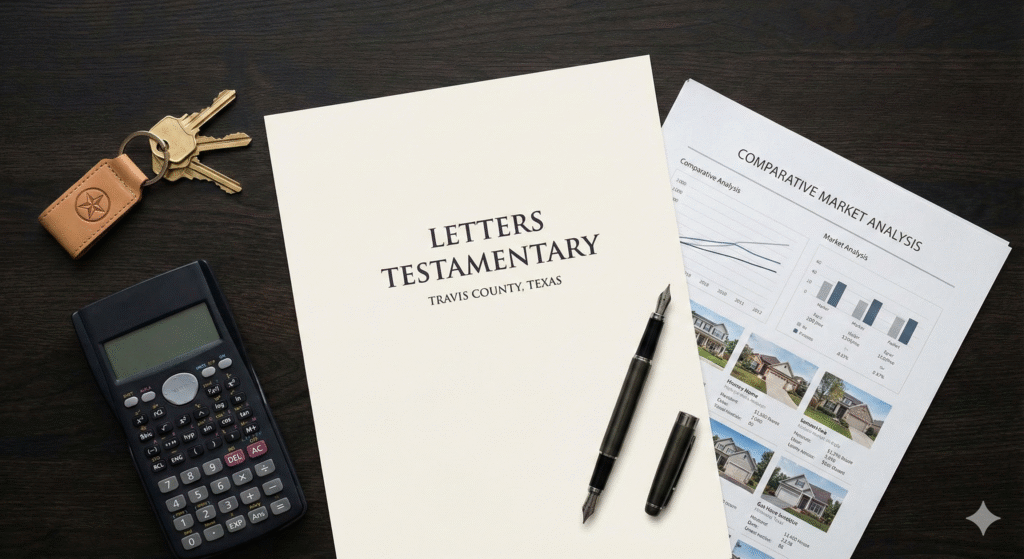
Timeline progression follows this pattern: Will filing occurs in week one. The court schedules an initial hearing anywhere from four weeks in rural counties to three to four months in major metropolitan areas. Once the judge approves the application and admits the will to probate, the executor receives Letters Testamentary—the legal document authorizing them to act on behalf of the estate.
With Letters Testamentary in hand, executors can immediately list the property for sale. No additional court approval is required for accepting offers or closing transactions. This independence accelerates the process significantly compared to dependent administration.
Travis County Probate Court currently schedules initial hearings three to four months after filing. Harris County operates four separate probate courts, and venue selection affects timing. For example, Probate Court No. 4 under current Judge Pfeuffer typically moves fastest for real estate matters. Dallas County averages two to three months to initial hearing across its three probate courts.
County Variations: Travis vs. Harris vs. Dallas Probate Court Procedures
County-specific procedures impact both timeline and documentation requirements. Travis County judges prefer detailed inventories listing all estate assets with specific valuations. This requirement means executors should obtain professional property appraisals before the initial hearing when possible.
Harris County's four probate courts each handle cases slightly differently. For example, Judge Pfeuffer (Court 4) emphasizes efficient case management and encourages early property sales when beneficial to estates. Judge McCoy (Court 1) requires more detailed accountings for larger estates.
Dallas County judges vary in their appraisal requirements. For example, Judge Brazzil in Probate Court No. 2 requires independent MAI appraisals for properties valued over $400,000. Other Dallas County judges accept county appraisal district values for most estates.
Letters Testamentary: Your Authorization to Sell
Letters Testamentary (or Letters of Administration for estates without wills) serve as the executor's proof of authority. These certified court documents show that the named individual has legal power to transfer estate property.
Real estate professionals verify executor authority before accepting listings. The Probate Realtor reviews certified copies of Letters Testamentary to ensure proper authorization exists. Title companies require these documents for closing, and buyers' attorneys verify them during due diligence.
This documentation accelerates sales dramatically compared to dependent administration, where executors must obtain specific court orders for each transaction. Independent administration with Letters Testamentary means listing, negotiating, and closing can proceed on market timelines rather than court schedules.
"Understanding when you can legally list an inherited property saves months of frustration. In independent administration—the most common in Texas—executors can begin marketing immediately after receiving Letters Testamentary, which typically takes six to nine months in major metros. I work with families to prepare the property for sale during probate so we're ready to launch the moment authorization comes through." – Dallas Seely
Five Legal Strategies to Minimize or Avoid Capital Gains Tax on Texas Inherited Property
Strategic planning reduces or eliminates capital gains tax liability entirely. These five approaches give executors and heirs practical options for minimizing federal tax obligations.
Strategy 1: Sell Quickly (Stepped-Up Basis Eliminates Most Gains)
Selling within six to twelve months of inheritance minimizes property appreciation and resulting capital gains. Texas real estate markets experience seasonal patterns that affect both pricing and timeline. Spring months from March through June typically yield highest prices, particularly in Austin neighborhoods like Tarrytown and Hyde Park. Fall months from September through November produce faster closings with fewer competing listings.
Properties listed in April in strong Austin markets frequently receive multiple offers 8% to 12% over asking price. Quick sales capitalize on stepped-up basis while avoiding extended appreciation exposure.
Strategy 2: Move In and Use the Primary Residence Exclusion
Internal Revenue Code Section 121 allows individuals to exclude $250,000 (single) or $500,000 (married filing jointly) in capital gains if they occupy the property as their primary residence for two of the five years before sale. This strategy works for heirs who can occupy the inherited property.
Texas homestead exemption provides additional benefits during occupancy. School district and county property taxes decrease significantly under homestead protection. If an inherited property appreciates $80,000 during your two-year occupancy, the entire gain escapes federal taxation when you sell.
The caveat: This strategy requires time and willingness to occupy the property. Executors managing estates from out of state rarely find this practical, but local heirs sometimes benefit significantly.

Strategy 3: Offset Gains with Capital Losses
Heirs with investment portfolios can harvest capital losses in the same tax year they sell inherited property. Capital losses offset capital gains dollar-for-dollar. If you sell inherited property with a $20,000 gain, selling stocks with a $20,000 loss eliminates your capital gains tax liability.
The IRS allows up to $3,000 in annual capital loss deductions against ordinary income. Losses exceeding this amount carry forward indefinitely to future tax years. Strategic loss harvesting coordinates inherited property sales with portfolio management.
Strategy 4: Deduct All Allowable Selling Costs
Maximizing legitimate selling cost deductions reduces taxable gains. Beyond obvious costs like realtor commissions and title insurance, executors should document all estate-paid expenses related to the sale:
- Attorney fees for contract review
- Survey costs required by buyers
- County recording fees
- HOA transfer fees and outstanding dues
- Utility deposits and final bills
- Property insurance during marketing period
Each documented expense reduces your capital gain calculation. The Probate Realtor provides executors with detailed closing statements identifying all deductible costs for tax preparation.
Strategy 5: Consider Strategic Repairs Before Sale
Foundation repairs, roof replacement, and major system upgrades qualify as deductible selling costs while simultaneously increasing sale price. The dual benefit—higher proceeds and lower taxable gain—makes strategic repairs valuable in many situations.
An Austin estate facing a $15,000 foundation repair might initially hesitate. Making the repair adds $20,000 to sale price while reducing capital gains by the $15,000 repair cost. The net financial impact: $5,000 additional proceeds plus eliminated tax liability on that gain.
The Probate Realtor evaluates which repairs make financial sense based on local market conditions and repair cost-to-value ratios in each Texas market.
Why Choose Dallas Seely to Sell Your Texas Inherited Property

Understanding capital gains tax represents step one in inherited property transactions. Executing a strategic sale that minimizes tax liability while maximizing net proceeds requires specialized expertise that traditional real estate agents simply don't possess.
With over $700 million in career sales, ranked in the top 0.1% of agents nationwide, and a probate attorney on staff, The Probate Realtor provides results traditional agents cannot match. Dallas's deep knowledge of Travis, Harris, Dallas, and Bexar County probate courts ensures your sale proceeds on the fastest legally compliant timeline. Having helped 300+ families annually navigate these complex intersections, Dallas brings practical experience to every estate sale.
Dallas Seely guides Texas families through every aspect of inherited property sales. From establishing stepped-up basis documentation that satisfies IRS requirements to coordinating with probate attorneys and CPAs for optimal tax outcomes, The Probate Realtor delivers comprehensive service beyond standard real estate transactions.
Learn more about Dallas Seely and his commitment to serving Texas executors and heirs during challenging transitions.
Call (512) 777-9530 today to discuss your inherited property sale and receive multiple offers within 24 hours.
Serving Texas Families Throughout Austin and Beyond
While this guide addresses capital gains tax questions for inherited property sales statewide, The Probate Realtor provides hands-on service throughout Texas's major markets. Dallas Seely understands that probate properties exist everywhere—from downtown high-rises to rural ranch land—and families often live far from the inherited home.
The Probate Realtor delivers specialized probate real estate services in all major Texas markets, including Austin, Dallas, Fort Worth, Houston, and San Antonio. Whether your inherited property sits in a Travis County neighborhood near the University of Texas, a Harris County suburb in The Woodlands, or rural Williamson County acreage, Dallas brings the same level of expertise and attention.
Distance never creates barriers with The Probate Realtor. Virtual consultations, remote document signing, and regular digital updates mean executors living out of state can manage the entire sale process without visiting Texas. From initial probate court filings to final closing and proceeds distribution, Dallas coordinates every detail while you stay informed from anywhere in the country.
Texas probate procedures vary by county, and local market dynamics shift by region. The Probate Realtor's statewide experience ensures you benefit from hyper-local knowledge regardless of where your inherited property is located.
Ready to Move Forward? Let's Talk About Your Inherited Property
Navigating probate real estate doesn't have to be overwhelming. Having the right guidance makes all the difference. Whether you've just begun the probate process or you're ready to sell an inherited property, we're here to help.
Why Families Trust Dallas Seely with Their Probate Real Estate
Dallas Seely founded The Probate Realtor to help Texas families through challenging transitions. He brings both expertise and empathy to every probate situation. Most importantly, he has a proven track record of results.
Proven Track Record:
- Over $700M in career sales
- Top 0.1% of agents nationwide
- Top 3 real estate professional in Texas
- Top 10 in Central Texas
- 300+ families served annually
These aren't just numbers. They represent hundreds of families who've successfully navigated probate real estate sales. Many did so during the most difficult times of their lives.
A Different Approach to Probate Real Estate
Most real estate agents treat inherited properties like standard listings. However, Dallas understands the unique pressures executors and heirs face.
Time-sensitive decisions create stress. Family dynamics add complexity. Property maintenance costs pile up. The weight of responsibility feels heavy. Because of these challenges, you need a specialized approach.
That's why Dallas developed a streamlined process. It eliminates the traditional hassles:
- No repairs or improvements needed. You can sell the property as-is.
- No lengthy listing periods. Move forward on your timeline.
- No showings or open houses. Avoid the disruption and stress.
- Multiple offers within 24 hours. Compare options and choose what works best.
This isn't about pushing a quick sale. Instead, it's about giving you real options. You'll get the information you need to make confident decisions during an uncertain time.
Comprehensive Support Beyond the Sale
The Probate Realtor offers more than just real estate services. We provide complete support throughout the entire process.
Full-Service Property Management: Managing an inherited property from a distance can be overwhelming. Therefore, we handle everything you need:
- Property clean-outs and estate sales. We coordinate professional services to clear the home.
- Vendor orchestration. We connect you with trusted contractors for any needed services.
- Regular property checks. Weekly inspections ensure the home stays secure.
- Title clearing and coordination. We work with title companies to resolve any issues.
Executor Support and Guidance: As an executor or heir, you're navigating unfamiliar territory. We provide hands-on coaching throughout the real estate aspects of probate:
- Clear explanations of each step in the process
- Coordination with estate attorneys and other professionals
- Guidance on timing and decision-making
- Support with family communication about the property
Legal Guidance from Probate Attorney on Staff: Questions about probate procedures don't wait for business hours. That's why The Probate Realtor has a probate attorney on staff. This unique resource means you get both real estate expertise and legal guidance in one place. Whether you need clarification on court requirements, executor responsibilities, or heir rights, you have direct access to legal counsel.
Guaranteed Responsiveness: Questions don't wait for business hours. That's why we guarantee a response within 24 hours. This commitment sets us apart in an industry where responsiveness is often lacking. Your questions are always welcome. Your concerns are always addressed promptly.
Statewide Texas Expertise with Remote Convenience
Dallas serves families throughout the entire state of Texas. He has a deep understanding of Texas probate procedures. Additionally, he knows local market conditions across all regions. He also understands the unique challenges of inherited property sales.
Primary Markets Served:
- Austin
- Dallas
- Fort Worth
- Houston
- San Antonio
Your inherited property might be in a major metropolitan area. Or it might be in a smaller community anywhere across the state. Either way, Dallas has the expertise and network to help you achieve the best possible outcome.
Virtual Consultations Available: Many heirs and executors don't live near the inherited property. Therefore, we offer complete remote services. You can handle everything virtually if needed:
- Initial consultations via video call
- Electronic document signing where permitted
- Regular updates via your preferred communication method
- Never need to visit the property if you choose not to
This flexibility means you can move forward regardless of where you live. Distance doesn't have to slow down the process.
How Quickly Can You Move Forward?
Speed matters when you're managing an estate. Here's what you can expect:
Within 24 Hours:
- Multiple offers on your property
- Initial consultation scheduled
- Questions answered
Within 2-3 Weeks:
- Property sold and closed (if you choose this timeline)
- Funds distributed according to estate requirements
- Property responsibilities lifted from your shoulders
Throughout the Process:
- Regular communication and updates
- Coordination with all necessary parties
- Support every step of the way
Get Started Today
Every day spent worrying about an inherited property is a day you don't get back. Let's start a conversation about your situation. There's no pressure and no obligation. Just honest guidance and real solutions.
Get Multiple Offers in 24 Hours
Text "Probate" to (512) 777-9530
Or Schedule a Free Consultation
Call (512) 777-9530 to speak directly with Dallas
Email: [email protected]
The probate process can feel heavy. But you don't have to carry it alone. Dallas Seely brings decades of experience and proven results. He's committed to serving families with compassion and integrity. Because of this, he's the trusted partner you need during this transition.
Serving families across Texas through life's hardest transitions.
Follow Us on Social Media
Follow Dallas Seely and The Probate Realtor on social media for Texas probate real estate insights, inherited property tips, and market updates. Connect with us on X (Twitter) and Instagram for expert guidance navigating Texas estate sales.
FAQ
Your capital gains tax depends on how much the property appreciated between inheritance and sale, not its original purchase price. Thanks to the stepped-up basis rule, your taxable gain equals only the difference between sale price and the property's fair market value at the date of death. For example, if you inherited a Texas property valued at $400,000 and sold it two years later for $425,000, your taxable gain is $25,000 (not the decades of appreciation before inheritance).
After deducting selling costs like realtor commissions ($25,500 on a 6% commission) and title insurance ($3,000), you would owe zero capital gains tax—your deductible costs exceed the gain. Most Texas heirs who sell within a few years of inheritance pay little to no capital gains tax due to this combination of stepped-up basis and deductible selling expenses. Federal long-term capital gains rates (if you do owe) are 0%, 15%, or 20% depending on your annual income, and Texas has no state capital gains tax.