Selling inherited property in Texas creates unique documentation challenges for executors and heirs. The process requires navigating both legal probate requirements and real estate transaction documents simultaneously. Understanding exactly which documents you need—and when you need them—can prevent costly delays and legal complications. In this blog post, Texas probate real estate expert Dallas Seely discusses the complete documentation requirements to sell probate property in Texas, covering both legal authorization and real estate transaction documents.
To sell probate property in Texas, executors need court-issued Letters Testamentary or Letters of Administration to establish authority. Additional required documents include the deceased’s death certificate, the original will (if one exists), a court-ordered inventory and appraisement, property survey, and Texas seller’s disclosure or exemption documentation. Dependent administration requires additional court approval orders before listing or accepting offers.
Key Takeaways
- Letters Testamentary or Letters of Administration establish executor authority to sell the property
- Independent administration requires fewer documents and allows faster sales than dependent administration
- Real estate transaction documents include surveys, disclosures, and title work beyond initial court authorization
- Multiple offers within 24 hours are available when working with probate specialists like The Probate Realtor
To Discuss Your Inherited Property Sale, Call or Text (512) 777-9530 Today for Multiple Offers Within 24 Hours.
Call Today To See How Much Your Inherited Property Is Worth – Sell Your Inherited Property Before Probate
Texas probate real estate expert Dallas Seely specializes in probate property sales throughout Texas, having guided hundreds of executors through the complex documentation process. With over $700 million in career sales and a probate attorney on staff, The Probate Realtor provides both real estate expertise and legal guidance families need during estate settlements. This unique combination ensures executors understand not only what documents are required, but how to obtain them efficiently.
Texas Probate Property Sale Document Timeline
Follow the key steps from start to closing, noting crucial differences between administration types.
1. Obtain Death Certificate
The foundational document for probate. Certified copies with a raised seal are required to initiate the process.
2. File for Probate
The original will and death certificate are submitted to the appropriate Texas county court to formally begin the probate case.
3. Receive Letters Testamentary
The court issues this critical document, granting the executor legal authority to manage and sell estate assets. The process path diverges from here.
4. List the Property for Sale
Independent Admin
Can list the property immediately after receiving Letters. No prior court approval is needed.
Dependent Admin
Requires Court Order. An application to sell must be filed and approved by a judge before marketing the property.
5. Execute Sales Contract
Independent Admin
The executor can review offers, negotiate terms, and sign a binding sales contract without court intervention.
Dependent Admin
Requires Court Approval. Once an offer is accepted, the contract must be submitted to the court for final approval.
6. Close the Sale
The final stage where all documents are signed at the title company, funds are disbursed, and ownership is officially transferred to the buyer.
The Essential Legal Documents for Texas Probate Court Authorization
The first category of documents involves court authorization to act as executor or administrator. These legal documents establish your authority to manage estate property, including real estate sales. Without proper court authorization, no real estate transaction can legally proceed.
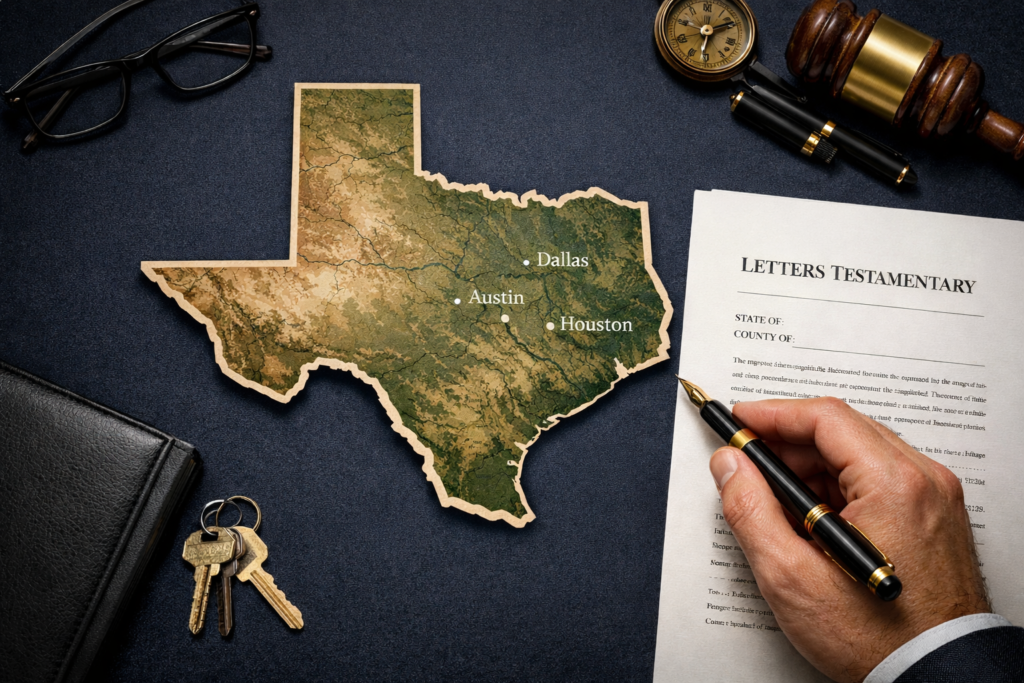
Death certificates form the foundation of all probate proceedings. Executors need certified copies with raised seals—photocopies or standard printouts are not acceptable. Most executors order 5-10 certified copies initially. The cost runs $20-$25 per copy in Texas. Death certificates are obtained through the county vital records office where the death occurred or through the Texas Department of State Health Services.
The original will and testament must be filed with the probate court if one exists. Texas courts require the actual signed document, not a copy. If no will exists, the executor must file a sworn statement confirming the deceased died intestate. This distinction determines whether you receive Letters Testamentary (with a will) or Letters of Administration (without a will).
Letters Testamentary or Letters of Administration represent the most critical documents. These court-issued papers legally authorize the executor to act on behalf of the estate. Without them, an executor has zero authority to sign contracts, accept offers, or transfer property ownership. The application process varies by county, but typically takes 2-6 weeks in major Texas metro areas.
The Inventory and Appraisement document lists all estate assets, including real property, with fair market values. Texas law requires executors to file this within 90 days of receiving Letters. The inventory must include a professional appraisal for real estate. Appraisal costs typically range from $300-$800 for residential properties. Missing this deadline can result in executor liability.
Executor bond requirements depend on will language and administration type. Most modern Texas wills waive bond requirements for independent executors. However, dependent administration typically requires posting a bond equal to the estate’s value. Bond costs vary based on estate size, averaging 0.5-1% of the bond amount annually.
Independent vs. Dependent Administration: Which Path Do You Need?
Texas offers two primary probate paths with dramatically different documentation requirements. Independent administration allows executors to manage estate affairs without ongoing court supervision. This includes selling property without prior court approval for each transaction. If the will includes language such as “independent executor” or “no action in probate court,” independent administration applies.
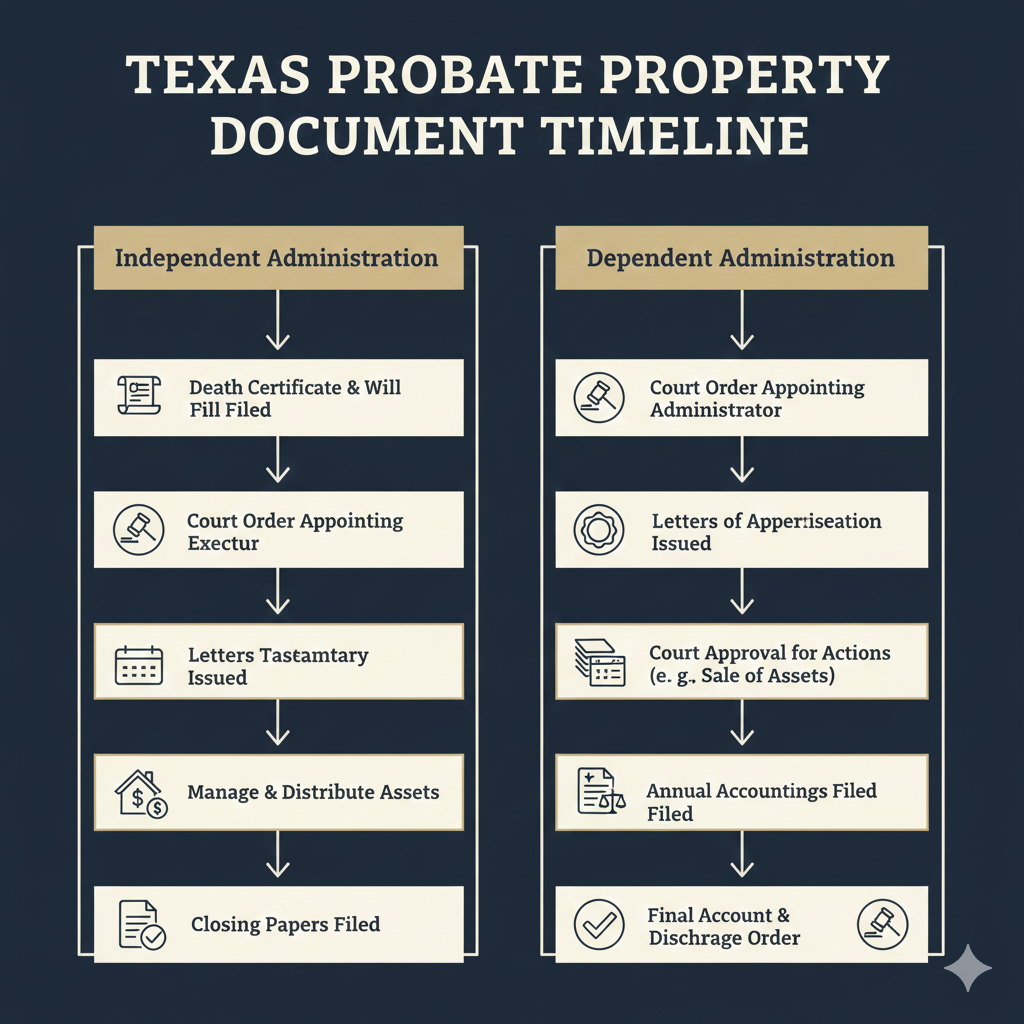
Dependent administration requires court approval for every major estate decision. Selling real property demands a specific court order authorizing each sale. This involves filing a formal application, publishing legal notices, conducting a hearing, and waiting for the judge’s signed order. The process adds 30-90 days minimum to the sale timeline.
The distinction matters significantly for document requirements and timelines. Independent administration executors can list property immediately after receiving Letters Testamentary. Dependent administration executors cannot legally list property until the court issues a sale authorization order. In Harris County, approximately 80% of probate cases proceed as independent administration due to efficiency advantages.
Independent vs. Dependent Administration in Texas: Document & Timeline Comparison
| Administration Type | Court Approval for Sale? | Timeline to Sell | Required Documents | Attorney Requirement | Average Cost |
|---|---|---|---|---|---|
| Independent | No (Executor acts freely) | Immediate (upon receiving Letters) | Fewer (Letters Testamentary) | Minimal court interaction | $3,000 – $7,000 |
| Dependent | Yes (Requires specific court order) | 30-90+ days longer | More (Letters + Application & Order to Sell) | Multiple hearings & ongoing oversight | $8,000 – $15,000+ |
Real Estate Transaction Documents Required for Texas Probate Property Sales
Beyond court authorization, executors must navigate standard real estate transaction documentation. These requirements often surprise executors who assume Letters Testamentary alone suffice. The Probate Realtor guides families through both legal and real estate documentation requirements.
Property surveys are required by most Texas title companies. The survey confirms property boundaries, improvements, and encroachments. ALTA surveys provide the most comprehensive information, while boundary surveys offer basic property line verification. Title companies typically reject surveys older than 12 months. Survey costs in Texas metro areas range from $350-$600 for residential properties.
The Seller’s Disclosure of Property Condition presents a unique situation for executors. Texas Property Code § 5.008 requires sellers to disclose known property defects. However, executors who never occupied the property and have no actual knowledge of defects may be exempt. This exemption must be documented properly to protect executors from future liability claims.
Title commitment review documents come from the title company during the transaction process. The commitment reveals any liens, judgments, or other encumbrances affecting the property. Common probate-related title issues include mechanics liens from pre-death repairs, property tax arrearages, and mortgage payoffs. Executors should review title commitments carefully before accepting offers.
Listing agreements for probate properties often require specific addenda. If using dependent administration, the listing agreement must clearly state that the sale is subject to court approval. This protects both the executor and the buyer’s agent. The Probate Realtor uses specialized listing agreements designed for Texas probate transactions.
The Texas Real Estate Commission 1-4 Family Residential Contract serves as the standard purchase agreement. Probate sales require specific addenda addressing executor authority, administration type, and court approval requirements. The contract must clearly identify the seller as “John Smith, Independent Executor of the Estate of Jane Smith, Deceased” or similar legal designation.
Court orders authorizing sale are mandatory for dependent administration. The executor must attach this court order to the purchase contract. Buyers and title companies will not proceed without this documentation. The order specifically describes the property and authorizes the executor to sell at or above a minimum price.
The T-47 Affidavit requires the executor to swear under oath that no improvements or repairs were made without proper permits. This affidavit protects the title company and buyer from unpermitted work liability. Executors who made repairs before understanding permit requirements face complications at closing.
When Can You List the Property for Sale?
Timing matters significantly in probate property sales. Independent administration executors can list property immediately upon receiving Letters Testamentary. This allows marketing to begin while handling other estate matters. Independent administration executors in Austin typically begin marketing properties within 60 days of filing.
Dependent administration executors cannot list property until the court issues an order authorizing sale. This requires filing an application, publishing notice to interested parties, and conducting a court hearing. The process typically takes 30-90 days minimum. Dependent administration executors in Dallas average 120 days before listing.
“Executors often underestimate how long document gathering takes. The Probate Realtor’s on-staff probate attorney helps families understand exactly what they need and when they need it. This proactive approach prevents the frustrating delays that occur when executors discover missing documents mid-transaction.” – Texas probate real estate expert Dallas Seely
See if we have buyers ready for your property
Enter the property address below to check our network of qualified buyers
Searching our network of qualified buyers…
Excellent News!
We specialize in helping families navigate probate property sales with compassion and expertise. Our proven process ensures you receive multiple offers and can close quickly during this difficult time.
How Long Does It Take to Get Letters Testamentary in Texas?
Processing times for Letters Testamentary vary significantly across Texas counties. Understanding county-specific timelines helps executors set realistic expectations. Texas law doesn't mandate specific processing times, but courts must "act with reasonable promptness."
Harris County (Houston) features specialized statutory probate courts with experienced judges. Independent administration applications typically receive Letters within 2-4 weeks. The county's electronic filing system speeds document processing considerably. Harris County processes more probate cases annually than any other Texas county.
Travis County (Austin) averages 3-6 weeks for Letters Testamentary in independent administration cases. The county operates statutory probate courts with dedicated probate dockets. Travis County offers expedited probate procedures for estates meeting certain criteria, though these remain less common than standard processing.
Dallas County typically issues Letters Testamentary within 3-5 weeks for straightforward independent administration cases. The county's probate courts handle high volumes, which can create backlogs during peak filing periods. However, specialized probate judges maintain consistent processing standards.
Bexar County (San Antonio) processes independent administration applications in 2-4 weeks on average. The county's statutory probate courts prioritize timely case processing. Bexar County recently implemented electronic filing, though not all documents qualify for e-filing yet.
Rural Texas counties often process Letters Testamentary faster than metro areas—sometimes in 1-2 weeks. However, fewer court staff and less frequent court sessions can create unpredictability. Some rural counties hold probate hearings only once or twice monthly.
Cost Breakdown: What Does It Cost to Sell Probate Property in Texas?
Understanding costs helps executors budget appropriately and avoid financial surprises. Texas probate costs vary based on administration type, estate complexity, and county location.
Probate court filing fees range from $300-$500+ depending on county. Harris County charges $351 for independent administration applications. Travis County fees run $386 for similar filings. These fees cover the initial application and Letters issuance. Additional court filings incur separate charges.
Attorney fees represent the largest variable cost:
- Independent administration: $3,000-$7,000 typically, due to minimal court interaction
- Dependent administration: $8,000-$15,000+ common, reflecting multiple hearings and ongoing court involvement
- Hourly rates in major Texas cities: $350-$500 per hour standard
Property appraisal costs for the required Inventory and Appraisement run $300-$800 for residential properties. Commercial properties or unique assets cost more. The appraiser must provide a detailed written report suitable for court filing.
Property surveys cost $350-$600 in Texas metro areas for standard residential properties. ALTA surveys providing comprehensive detail cost more than basic boundary surveys. Rural properties with large acreage increase survey costs significantly.
Title policy costs vary by property sale price. Texas uses a promulgated rate structure for title insurance. Executors pay the seller's title policy premium, typically 0.5-1% of the sale price. Additional endorsements increase costs slightly.
Real estate commissions typically total 6% (3% listing agent, 3% buyer's agent). The Probate Realtor offers competitive commission rates for probate properties. Commission is paid from sale proceeds at closing, not upfront.
In San Antonio, executors using independent administration save an average of $7,000 in legal fees compared to dependent administration. Fort Worth probate attorneys charge similar rates to Dallas, averaging $350-$500 per hour for dependent administration oversight.
Common Documentation Mistakes That Delay Texas Probate Property Sales
Avoiding common errors saves time and prevents costly complications. These mistakes appear repeatedly in Texas probate property transactions.
- Mistake #1: Filing uncertified death certificate copies. Courts require certified originals with raised seals. Standard photocopies or printouts are universally rejected. Executors should order extra certified copies initially—obtaining additional copies later creates delays.
- Mistake #2: Missing the Notice to Creditors publication deadline. Texas Estates Code § 308.002 requires publishing notice in specific newspapers within statutory timeframes. Missing this deadline affects creditor claim periods and can delay final estate settlement significantly.
- Mistake #3: Using outdated property surveys. Many title companies reject surveys older than 12 months. Executors often try using surveys the deceased received decades ago. These rarely satisfy title company requirements. In Travis County, title companies are particularly strict about survey age requirements.
- Mistake #4: Signing contracts before receiving Letters Testamentary. Some eager executors sign listing agreements or purchase contracts before court authorization. These agreements are voidable and create legal complications. Wait for Letters before signing any real estate documents.
- Mistake #5: Omitting required probate addenda from contracts. Standard real estate contracts need specific probate modifications. Dependent administration sales must clearly state court approval is required. Missing these addenda causes contract disputes and closing delays.
- Mistake #6: Missing the 90-day inventory filing deadline. Texas executors must file the Inventory and Appraisement within 90 days of receiving Letters. Late filing can result in executor personal liability. In Harris County, executors frequently encounter delays when they submit the Inventory without the required appraisal attachment—a common oversight probate courts immediately reject.
"The documentation process overwhelms most executors because they're navigating unfamiliar legal and real estate requirements simultaneously. Having a probate attorney on staff means The Probate Realtor can answer both legal and real estate questions immediately. This integrated support prevents the costly mistakes that occur when executors work with professionals who don't communicate effectively." - Texas probate real estate expert Dallas Seely
Why Choose Dallas Seely to Navigate Texas Probate Property Sales
Texas probate real estate expert Dallas Seely provides comprehensive guidance through both legal and real estate documentation requirements. Instead of coordinating between a probate attorney and a general real estate agent, Texas families get both perspectives from one trusted advisor. The Probate Realtor's on-staff probate attorney answers legal questions while Dallas handles real estate transaction documentation seamlessly. This integrated approach eliminates the confusion and delays that occur when legal and real estate professionals work independently. Call (512) 777-9530 today to discuss your inherited property documentation requirements with a certified probate specialist who understands the complete process.
Serving Texas Families Throughout Austin and Beyond

While documentation requirements remain consistent statewide, county-specific procedures vary significantly across Texas. The Probate Realtor understands these local variations through extensive experience in major Texas metro areas.
Whether managing probate property sales in Austin, Dallas, Fort Worth, Houston, or San Antonio, The Probate Realtor understands county-specific probate court procedures and title company requirements. This local knowledge prevents the documentation errors that delay sales in specific jurisdictions.
Dallas Seely serves families throughout Texas, including rural communities and smaller counties statewide. Distance never creates barriers—remote consultations and electronic document handling allow efficient service regardless of property location. The combination of statewide reach and deep local expertise makes The Probate Realtor uniquely qualified to handle complex documentation requirements across all Texas jurisdictions.
Ready to Move Forward? Let's Talk About Your Inherited Property
Navigating probate real estate doesn't have to be overwhelming. Having the right guidance makes all the difference. Whether you've just begun the probate process or you're ready to sell an inherited property, we're here to help.
Why Families Trust Dallas Seely with Their Probate Real Estate
Dallas Seely founded The Probate Realtor to help Texas families through challenging transitions. He brings both expertise and empathy to every probate situation. Most importantly, he has a proven track record of results.
Proven Track Record:
- Over $700M in career sales
- Top 0.1% of agents nationwide
- Top 3 real estate professional in Texas
- Top 10 in Central Texas
- 300+ families served annually
These aren't just numbers. They represent hundreds of families who've successfully navigated probate real estate sales. Many did so during the most difficult times of their lives.
A Different Approach to Probate Real Estate
Most real estate agents treat inherited properties like standard listings. However, Dallas understands the unique pressures executors and heirs face.
Time-sensitive decisions create stress. Family dynamics add complexity. Property maintenance costs pile up. The weight of responsibility feels heavy. Because of these challenges, you need a specialized approach.
That's why Dallas developed a streamlined process. It eliminates the traditional hassles:
- No repairs or improvements needed. You can sell the property as-is.
- No lengthy listing periods. Move forward on your timeline.
- No showings or open houses. Avoid the disruption and stress.
- Multiple offers within 24 hours. Compare options and choose what works best.
This isn't about pushing a quick sale. Instead, it's about giving you real options. You'll get the information you need to make confident decisions during an uncertain time.
Comprehensive Support Beyond the Sale
The Probate Realtor offers more than just real estate services. We provide complete support throughout the entire process.
Full-Service Property Management: Managing an inherited property from a distance can be overwhelming. Therefore, we handle everything you need:
- Property clean-outs and estate sales. We coordinate professional services to clear the home.
- Vendor orchestration. We connect you with trusted contractors for any needed services.
- Regular property checks. Weekly inspections ensure the home stays secure.
- Title clearing and coordination. We work with title companies to resolve any issues.
Executor Support and Guidance: As an executor or heir, you're navigating unfamiliar territory. We provide hands-on coaching throughout the real estate aspects of probate:
- Clear explanations of each step in the process
- Coordination with estate attorneys and other professionals
- Guidance on timing and decision-making
- Support with family communication about the property
Legal Guidance from Probate Attorney on Staff: Questions about probate procedures don't wait for business hours. That's why The Probate Realtor has a probate attorney on staff. This unique resource means you get both real estate expertise and legal guidance in one place. Whether you need clarification on court requirements, executor responsibilities, or heir rights, you have direct access to legal counsel.
Guaranteed Responsiveness: Questions don't wait for business hours. That's why we guarantee a response within 24 hours. This commitment sets us apart in an industry where responsiveness is often lacking. Your questions are always welcome. Your concerns are always addressed promptly.
Statewide Texas Expertise with Remote Convenience
Dallas serves families throughout the entire state of Texas. He has a deep understanding of Texas probate procedures. Additionally, he knows local market conditions across all regions. He also understands the unique challenges of inherited property sales.
Primary Markets Served:
- Austin
- Dallas
- Fort Worth
- Houston
- San Antonio
Your inherited property might be in a major metropolitan area. Or it might be in a smaller community anywhere across the state. Either way, Dallas has the expertise and network to help you achieve the best possible outcome.
Virtual Consultations Available: Many heirs and executors don't live near the inherited property. Therefore, we offer complete remote services. You can handle everything virtually if needed:
- Initial consultations via video call
- Electronic document signing where permitted
- Regular updates via your preferred communication method
- Never need to visit the property if you choose not to
This flexibility means you can move forward regardless of where you live. Distance doesn't have to slow down the process.
How Quickly Can You Move Forward?
Speed matters when you're managing an estate. Here's what you can expect:
Within 24 Hours:
- Multiple offers on your property
- Initial consultation scheduled
- Questions answered
Within 2-3 Weeks:
- Property sold and closed (if you choose this timeline)
- Funds distributed according to estate requirements
- Property responsibilities lifted from your shoulders
Throughout the Process:
- Regular communication and updates
- Coordination with all necessary parties
- Support every step of the way
Get Started Today
Every day spent worrying about an inherited property is a day you don't get back. Let's start a conversation about your situation. There's no pressure and no obligation. Just honest guidance and real solutions.
Get Multiple Offers in 24 Hours
Text "Probate" to (512) 777-9530
Or Schedule a Free Consultation
Call (512) 777-9530 to speak directly with Dallas
Email: [email protected]
The probate process can feel heavy. But you don't have to carry it alone. Dallas Seely brings decades of experience and proven results. He's committed to serving families with compassion and integrity. Because of this, he's the trusted partner you need during this transition.
Serving families across Texas through life's hardest transitions.
Follow Us on Social Media
Follow Dallas Seely and The Probate Realtor on social media for Texas probate real estate insights, inherited property tips, and market updates. Connect with us on X (Twitter) and Instagram for expert guidance.
FAQ
The most critical document for selling probate property in Texas is the Letters Testamentary (for testate estates with a will) or Letters of Administration (for intestate estates without a will). These court-issued documents legally authorize the executor or administrator to act on behalf of the estate, including listing and selling real property. Without Letters Testamentary or Letters of Administration, an executor has zero legal authority to sign contracts, accept offers, or transfer property ownership.
In independent administration cases (the most common in Texas), executors can proceed with real estate transactions immediately upon receiving Letters. In dependent administration cases, executors must also obtain a court order specifically authorizing each property sale. The application process typically takes 2-6 weeks in major Texas counties like Harris, Travis, Dallas, and Bexar.
Learn more about Dallas Seely's expertise in navigating Texas probate documentation requirements.
Call (512) 777-9530 for guidance on obtaining the proper documentation for your inherited property sale.