Determining the fair market value of an inherited property in Austin creates both legal and financial pressure for executors and heirs. The valuation must satisfy Travis County Probate Court requirements, establish the correct tax basis for the IRS, and guide your decision about selling, keeping, or renting the property. Choosing the wrong valuation method can result in probate court delays, IRS penalties, or selling the property for thousands of dollars below its true market value. Understanding the three accepted methods—certified appraisals, realtor CMAs, and TCAD assessments—helps you select the right approach for your specific situation. In this blog post, Texas probate real estate expert Dallas Seely discusses how to determine the fair market value of an inherited property in Austin, Texas.
Key Takeaways
- Certified appraisers provide the most legally defensible FMV for IRS and Travis County Probate Court requirements ($400-$800+ in Austin)
- Realtor CMAs offer free, accurate market valuations ideal for setting sale prices in Austin’s competitive market
- TCAD assessments are free but typically undervalue Austin properties by 15-25% and lack legal weight for probate
- Date of death valuation is mandatory for tax purposes—retrospective appraisals must be performed by Texas-licensed professionals
To determine the fair market value of an inherited property in Austin, you need a valuation as of the date of death for IRS and probate purposes. The three accepted methods are: hiring a certified appraiser ($400-$800+), obtaining a realtor’s comparative market analysis (CMA), or using the Travis Central Appraisal District assessment. A certified appraiser provides the most legally defensible valuation for Travis County Probate Court.
To Discuss Your Inherited Property Sale, Call or Text (512) 777-9530 Today for Multiple Offers Within 24 Hours.
Call Today To See How Much Your Inherited Property Is Worth – Sell Your Inherited Property Before Probate
Dallas Seely specializes in probate real estate throughout Texas, having helped hundreds of executors and heirs navigate inherited property valuations and sales in Austin. With over $700 million in career sales, recognition as a Top 0.1% agent nationwide, and a probate attorney on staff, The Probate Realtor provides both real estate expertise and legal guidance families need during probate. Dallas’s deep understanding of Travis County Probate Court procedures and Austin market conditions ensures accurate valuations that satisfy both court requirements and family needs.
Why Fair Market Value Matters for Inherited Properties in Austin
Fair Market Value (FMV) represents the price a willing buyer would pay a willing seller in an arm’s-length transaction. This seemingly simple definition carries tremendous weight for executors and heirs managing inherited properties in Austin. The accurate determination of FMV serves three critical purposes simultaneously, each with significant financial implications.
The IRS requires FMV on the date of death to establish the “stepped-up basis” for capital gains tax calculations. This stepped-up basis means heirs receive a fresh start for tax purposes. Rather than inheriting the original purchase price as the cost basis, heirs inherit the property valued at its FMV on the date of death. Consequently, any appreciation that occurred during the deceased’s lifetime becomes tax-free to the heirs.
Travis County Probate Court may require FMV appraisals for estate inventory or to approve property sales. The court’s requirements vary depending on whether the estate operates under dependent or independent administration. Additionally, accurate FMV prevents underpricing or overpricing the property in Austin’s competitive market, ensuring families receive fair value when selling.
Understanding Stepped-Up Basis: Tax Benefits for Austin Heirs
The stepped-up basis provision offers substantial tax advantages for heirs of appreciated Austin properties. Consider a property purchased in 1995 for $150,000 that has a fair market value of $650,000 at the date of death in 2024. The heirs’ tax basis becomes $650,000, not the original $150,000 purchase price. If heirs sell the property shortly after inheriting for $650,000, they owe zero capital gains tax on the $500,000 appreciation.
This tax benefit makes accurate date-of-death valuation critically important. An undervalued property creates unnecessary capital gains taxes if sold later. An overvalued property might trigger IRS scrutiny during an audit. Proper documentation of the valuation method and supporting comparable sales protects heirs from tax complications.
Three Methods to Determine Fair Market Value of Inherited Property in Austin
Executors and heirs in Austin have three primary options for determining an inherited property’s fair market value. Each method has different costs, legal weight, and accuracy levels depending on specific needs. Understanding these differences helps families make informed decisions about which valuation approach best serves their situation.
Method 1: Certified Appraisal—The Gold Standard for Legal Purposes
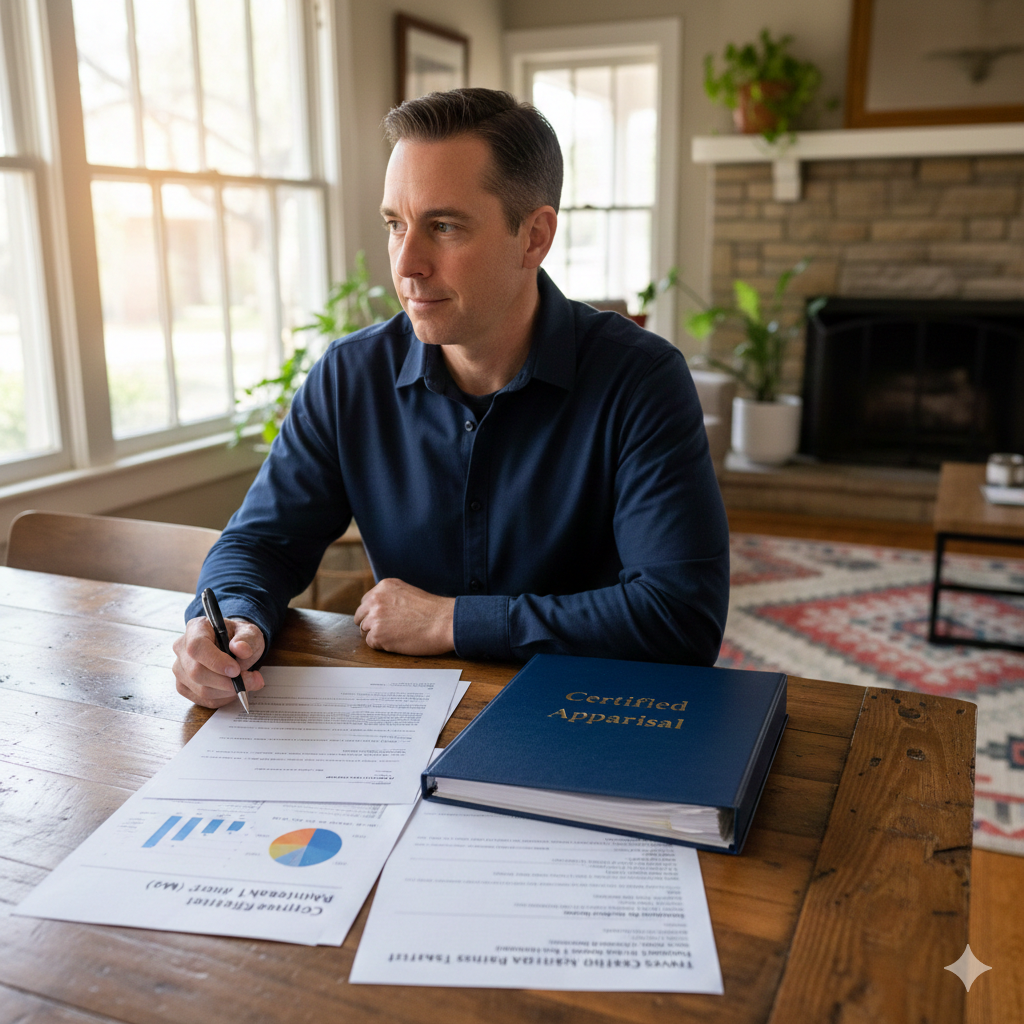
A certified appraisal involves a licensed appraiser who inspects the property and researches comparable sales to create a detailed valuation report. In Austin, certified appraisals typically cost $400-$800+ depending on property size and complexity. Most appraisers complete reports within 1-2 weeks of the initial inspection.
Travis County Probate Court accepts certified appraisals as the gold standard for estate inventory and sale approvals. The IRS also accepts certified appraisals to satisfy substantiation requirements for stepped-up basis claims. Certified appraisals work best for properties requiring court approval for sale, complex estates with multiple heirs, or situations where potential IRS audits create concerns.
Importantly, certified appraisers can perform “retrospective appraisals” that value the property as of the date of death even if performed months later. This capability proves valuable when families need time to settle other estate matters before addressing property valuation. All certified appraisers must hold licenses from the Texas Appraiser Licensing and Certification Board (TALCB).
Method 2: Realtor’s Comparative Market Analysis (CMA)—Fast and Free
A realtor’s comparative market analysis (CMA) involves analyzing recent sales of similar properties in the Austin area. The Probate Realtor provides CMAs typically free of charge when working with families on inherited property sales. Most CMAs can be completed within 24-48 hours, making them the fastest valuation option available.
Travis County Probate Court may accept CMAs for less complex estates, particularly in independent administrations where court oversight is minimal. The IRS accepts CMAs if prepared by qualified real estate professionals using comparable sales data and accepted valuation methodologies. CMAs excel at determining realistic sale prices and facilitating quick estate settlements when court approval is not required.
Austin’s competitive real estate market makes current CMAs more accurate than TCAD values for pricing strategy. The Probate Realtor provides free CMAs specifically for inherited properties, with expertise in Austin probate sales that ensures valuations account for property condition, neighborhood dynamics, and current market trends.
“For most Austin executors planning to sell an inherited property, a professional CMA provides the perfect balance of accuracy and speed. We analyze recent sales in the specific neighborhood—whether it’s Zilker, Circle C, or North Austin—and account for current market conditions. This gives families an actionable valuation within 24 hours at no cost.” — Dallas Seely
Method 3: Travis Central Appraisal District (TCAD) Assessment—Free But Limited
The Travis Central Appraisal District (TCAD) provides property valuations for tax assessment purposes. These valuations are free and immediately available online at traviscad.org. However, TCAD assessments carry significant limitations for inherited property valuation purposes.
Travis County Probate Court rarely accepts TCAD values alone for estate purposes due to their mass appraisal methodology. The IRS may accept TCAD values for simple estates but generally prefers certified appraisals or professionally prepared CMAs. Most significantly, TCAD values in Austin typically run 15-25% below actual market value, creating substantial undervaluation risk.
TCAD uses mass appraisal techniques that cannot account for individual property condition, recent upgrades, or rapidly changing Austin neighborhood dynamics. While TCAD assessments provide useful reference points, executors should never rely on them as the sole valuation source for inherited properties.
Travis County Probate Court Requirements for Property Valuations
Travis County Probate Court in Austin has specific requirements for inherited property valuations depending on whether the estate operates in dependent or independent administration. Understanding these requirements prevents court delays and ensures property valuations will be accepted. The type of administration significantly affects valuation timing, documentation needs, and sale approval processes.
Dependent Administration: Court-Supervised Valuations
Dependent administration means the court oversees every step of estate administration, including property sales. The court typically requires a certified appraisal for the estate inventory within 90 days of executor appointment. This appraisal must be performed by a Texas-licensed appraiser and submitted with other estate assets in the formal inventory filing.
When selling property under dependent administration, executors must file an “Application for Authority to Sell Real Property” with Travis County Probate Court. The court applies the “90% rule”—if the estate receives an offer below 90% of the appraised value, the court may require a new hearing or reject the sale entirely. This court approval process typically adds 30-60 days to the property sale timeline.
Dependent administration becomes required for estates without valid wills, complex family situations, or disputes among heirs. While providing oversight protection, dependent administration creates additional steps that slow the property sale process considerably.
Independent Administration: Streamlined Process
Independent administration gives executors authority to act without court approval for most decisions. This administration type is most common in Texas when the will specifically grants independent executor powers or all heirs agree to independent administration. Under this structure, no court-mandated appraisal requirement exists in most cases.
Even without court requirements, obtaining a professional CMA or appraisal protects executors from potential heir disputes about property value. Independent executors can accept any reasonable offer without court approval, allowing properties to be sold in as little as 2-3 weeks with willing buyers. This timeline advantage makes independent administration highly preferable when available.
Executors should maintain valuation records (CMA or appraisal) in the estate file for IRS documentation and heir transparency. This documentation proves the executor acted responsibly and obtained fair market value for estate property.
“Texas independent administration is a tremendous advantage for families selling inherited property in Austin. Unlike dependent administration, which requires court oversight and adds 30-60 days to the process, independent executors can move quickly once they have a solid valuation. We often help families close within 2-3 weeks when they’re ready to sell.” — Dallas Seely

Required Documentation for Travis County Probate Court
Regardless of administration type, executors should maintain comprehensive documentation:
- Estate inventory listing all real property with current valuations
- Appraisal reports or CMAs supporting all listed property values
- Letters testamentary or letters of administration proving executor authority
- Property deed showing ownership and complete legal description
- Death certificate establishing the precise date of death for valuation purposes
For specific Travis County Probate Court questions, executors can contact the court directly at 1000 Guadalupe St, Austin, TX 78701, or call (512) 854-9457. Court staff can clarify filing requirements and timeline expectations for estate property valuations.
How Austin’s Unique Market Conditions Affect Your Inherited Property Value
Austin’s rapidly appreciating real estate market creates unique challenges for inherited property valuations. Understanding how neighborhood-specific factors, TCAD assessment gaps, and current market trends affect property values helps executors and heirs make informed decisions. Generic valuation approaches fail to account for Austin’s distinctive market characteristics that can impact values by tens of thousands of dollars.
The TCAD Gap: Why Tax Assessments Undervalue Austin Properties
TCAD assessed values in Austin consistently run 15-25% below actual market values. This pattern occurs because TCAD uses mass appraisal models updated annually, while Austin’s market appreciates monthly in many neighborhoods. The gap between TCAD values and actual market values varies significantly by location.
In Zilker (78704), TCAD values often fall 20-25% below market due to exceptionally high demand and extremely limited inventory. Circle C (78749) typically shows TCAD values 15-18% below market. North Austin (78758) demonstrates closer alignment with 10-15% gaps due to higher inventory levels and more predictable appreciation patterns.
Executors who rely solely on TCAD values risk selling properties for tens of thousands below true market value. A property with a $400,000 TCAD assessment might sell for $500,000-$520,000 in current market conditions. That $100,000+ difference represents money that should go to heirs, not be left on the table due to inadequate valuation.
Austin Neighborhood Valuation Factors Inherited Property Owners Must Consider
Several Austin-specific factors significantly impact inherited property values:
- School District Impact: Properties in Eanes ISD command 15-20% premiums over comparable AISD properties due to perceived school quality
- University of Texas Proximity: Homes near UT campus attract investor demand but may appraise lower due to student rental wear patterns
- Downtown Austin Access: Properties within 15 minutes of downtown during non-peak traffic hours command significant premiums
- Lake Access: Homes near Lady Bird Lake, Lake Austin, or Lake Travis can have values 30-50% above comparable non-waterfront properties
- Historic District Status: Travis Heights, Hyde Park, and similar neighborhoods have unique valuation considerations due to renovation restrictions
- New Development Impact: Mueller, Domain, and other master-planned communities benefit from abundant recent comparable sales
Professional appraisers and realtors familiar with Austin understand these nuances. National valuation models or out-of-area professionals often miss these critical local factors, producing inaccurate valuations that cost families money.
Current Austin Market Timing Considerations (2024-2025)
Austin’s inventory levels remain below historical averages, creating seller-favorable conditions for inherited properties. Spring months (March-May) and fall months (September-October) typically produce the highest sale prices due to seasonal buyer demand patterns. Current interest rate environments affect buyer purchasing power and comparable sales selection for appraisals.
Austin properties continue appreciating 3-8% annually depending on neighborhood characteristics. This ongoing appreciation means valuations become outdated quickly. A six-month-old appraisal may undervalue a property by $15,000-$30,000 in rapidly appreciating neighborhoods.
Common Inherited Property Valuation Mistakes Austin Executors Should Avoid
Several common mistakes cost Austin executors and heirs thousands of dollars during the inherited property valuation process. Avoiding these errors protects estate assets and ensures families receive fair value.
Mistake #1: Using Only TCAD Value Without Professional Verification
The most expensive mistake involves assuming TCAD values accurately reflect market conditions. In neighborhoods like Zilker or Tarrytown, this assumption can cost families $100,000 or more. Professional CMAs take 24-48 hours and prevent leaving substantial money on the table when selling.
Mistake #2: Delaying Valuation Too Long After Death
The IRS requires date-of-death valuations for stepped-up basis calculations. Waiting months after death makes retrospective appraisals more expensive and less accurate. Market conditions change, making it harder to establish what the property was worth months earlier. Executors should contact appraisers or realtors within 30-60 days of death.
Mistake #3: Hiring General Appraiser Without Probate Experience
General residential appraisers may lack experience with retrospective valuations or Travis County Probate Court documentation requirements. Their reports may prove inadequate for court purposes. Executors should specifically request appraisers experienced in Texas probate and estate work.
Mistake #4: Ignoring Property Condition Issues in Valuation
Failing to disclose deferred maintenance or property condition issues to appraisers results in overvaluation. When buyers discover problems during inspections, deals fall through. Transparency about property condition leads to accurate valuations and realistic expectations.
Mistake #5: Not Documenting Valuation Methodology for IRS
Without proper documentation, IRS audits can challenge stepped-up basis claims. Executors should keep detailed records of appraisal reports, CMA documents, and comparable sales data used to establish values.
“The most expensive mistake I see Austin executors make is assuming the TCAD value is accurate. In neighborhoods like Zilker or Tarrytown, that assumption can cost families $100,000 or more. A professional valuation takes 24-48 hours and prevents leaving money on the table when it’s time to sell.” — Dallas Seely
Why Choose Dallas Seely to Determine Fair Market Value of Your Inherited Austin Property
Dallas Seely founded The Probate Realtor to help Texas families navigate the complex process of valuing and selling inherited properties. His specialization in probate real estate means he understands both Travis County Probate Court requirements and the Austin market dynamics that affect inherited property values. With over $700 million in career sales and recognition as a Top 0.1% agent nationwide, Dallas has the track record to ensure property valuations are accurate and defensible.
Most importantly, The Probate Realtor provides free comparative market analyses (CMAs) specifically designed for inherited properties in Austin. This no-cost service gives executors and heirs professional valuation guidance within 24 hours, helping families make confident decisions about selling, keeping, or renting inherited properties. Additionally, having a probate attorney on staff means families receive both real estate and legal guidance from one trusted source.
To request your free inherited property valuation, call or text (512) 777-9530 or visit theprobaterealtor.com today. Learn more about Dallas Seely and his commitment to serving Texas families through difficult transitions.
Serving Texas Families Throughout Austin and Beyond
While this guide focuses on determining fair market value of inherited properties in Austin, The Probate Realtor serves executors and heirs throughout Texas. Dallas Seely understands that probate properties can be located anywhere in the state, and families often live far from the inherited home. The valuation principles discussed in this article apply across Texas, though specific probate court procedures and market conditions vary by county and city.

The Probate Realtor provides specialized probate real estate services in all major Texas markets, including Austin, Dallas, Fort Worth, Houston, and San Antonio. Each market has unique probate court procedures and property valuation considerations that Dallas’s team understands deeply.
Whether your inherited property is in a major metropolitan area like Austin or Dallas, or a smaller Texas community, The Probate Realtor can help. With remote consultation capabilities and a statewide network of probate professionals, distance is never a barrier to receiving expert inherited property valuation guidance.
For inherited properties in Austin specifically, Dallas Seely’s deep knowledge of Travis County Probate Court procedures, TCAD valuation patterns, and neighborhood-specific market dynamics ensures you receive accurate, actionable valuation advice that satisfies both legal requirements and practical sale needs.
Ready to Move Forward? Let’s Talk About Your Inherited Property
Navigating probate real estate doesn’t have to be overwhelming. Having the right guidance makes all the difference. Whether you’ve just begun the probate process or you’re ready to sell an inherited property, we’re here to help.
Why Families Trust Dallas Seely with Their Probate Real Estate
Dallas Seely founded The Probate Realtor to help Texas families through challenging transitions. He brings both expertise and empathy to every probate situation. Most importantly, he has a proven track record of results.
Proven Track Record:
- Over $700M in career sales
- Top 0.1% of agents nationwide
- Top 3 real estate professional in Texas
- Top 10 in Central Texas
- 300+ families served annually
These aren’t just numbers. They represent hundreds of families who’ve successfully navigated probate real estate sales. Many did so during the most difficult times of their lives.
A Different Approach to Probate Real Estate
Most real estate agents treat inherited properties like standard listings. However, Dallas understands the unique pressures executors and heirs face.
Time-sensitive decisions create stress. Family dynamics add complexity. Property maintenance costs pile up. The weight of responsibility feels heavy. Because of these challenges, you need a specialized approach.
That’s why Dallas developed a streamlined process. It eliminates the traditional hassles:
- No repairs or improvements needed. You can sell the property as-is.
- No lengthy listing periods. Move forward on your timeline.
- No showings or open houses. Avoid the disruption and stress.
- Multiple offers within 24 hours. Compare options and choose what works best.
This isn’t about pushing a quick sale. Instead, it’s about giving you real options. You’ll get the information you need to make confident decisions during an uncertain time.
Comprehensive Support Beyond the Sale
The Probate Realtor offers more than just real estate services. We provide complete support throughout the entire process.
Full-Service Property Management: Managing an inherited property from a distance can be overwhelming. Therefore, we handle everything you need:
- Property clean-outs and estate sales. We coordinate professional services to clear the home.
- Vendor orchestration. We connect you with trusted contractors for any needed services.
- Regular property checks. Weekly inspections ensure the home stays secure.
- Title clearing and coordination. We work with title companies to resolve any issues.
Executor Support and Guidance: As an executor or heir, you’re navigating unfamiliar territory. We provide hands-on coaching throughout the real estate aspects of probate:
- Clear explanations of each step in the process
- Coordination with estate attorneys and other professionals
- Guidance on timing and decision-making
- Support with family communication about the property
Legal Guidance from Probate Attorney on Staff: Questions about probate procedures don’t wait for business hours. That’s why The Probate Realtor has a probate attorney on staff. This unique resource means you get both real estate expertise and legal guidance in one place. Whether you need clarification on court requirements, executor responsibilities, or heir rights, you have direct access to legal counsel.
Guaranteed Responsiveness: Questions don’t wait for business hours. That’s why we guarantee a response within 24 hours. This commitment sets us apart in an industry where responsiveness is often lacking. Your questions are always welcome. Your concerns are always addressed promptly.
Statewide Texas Expertise with Remote Convenience
Dallas serves families throughout the entire state of Texas. He has a deep understanding of Texas probate procedures. Additionally, he knows local market conditions across all regions. He also understands the unique challenges of inherited property sales.
Primary Markets Served:
- Austin
- Dallas
- Fort Worth
- Houston
- San Antonio
Your inherited property might be in a major metropolitan area. Or it might be in a smaller community anywhere across the state. Either way, Dallas has the expertise and network to help you achieve the best possible outcome.
Virtual Consultations Available: Many heirs and executors don’t live near the inherited property. Therefore, we offer complete remote services. You can handle everything virtually if needed:
- Initial consultations via video call
- Electronic document signing where permitted
- Regular updates via your preferred communication method
- Never need to visit the property if you choose not to
This flexibility means you can move forward regardless of where you live. Distance doesn’t have to slow down the process.
How Quickly Can You Move Forward?
Speed matters when you’re managing an estate. Here’s what you can expect:
Within 24 Hours:
- Multiple offers on your property
- Initial consultation scheduled
- Questions answered
Within 2-3 Weeks:
- Property sold and closed (if you choose this timeline)
- Funds distributed according to estate requirements
- Property responsibilities lifted from your shoulders
Throughout the Process:
- Regular communication and updates
- Coordination with all necessary parties
- Support every step of the way
Get Started Today
Every day spent worrying about an inherited property is a day you don’t get back. Let’s start a conversation about your situation. There’s no pressure and no obligation. Just honest guidance and real solutions.
Get Multiple Offers in 24 Hours
Text “Probate” to (512) 777-9530
Or Schedule a Free Consultation
Call (512) 777-9530 to speak directly with Dallas
Email: [email protected]
The probate process can feel heavy. But you don’t have to carry it alone. Dallas Seely brings decades of experience and proven results. He’s committed to serving families with compassion and integrity. Because of this, he’s the trusted partner you need during this transition.
Serving families across Texas through life’s hardest transitions.
Follow Us on Social Media
Follow Dallas Seely and The Probate Realtor on social media for Texas probate real estate insights, inherited property tips, and market updates. Connect with us on X (Twitter) and Instagram for expert guidance.
FAQ
The timeline for determining fair market value depends on the method chosen. A certified appraisal typically takes 1-2 weeks from initial contact to completed report, costing $400-$800+ in Austin. A realtor’s comparative market analysis (CMA) can be completed within 24-48 hours and is often provided free of charge by probate specialists like The Probate Realtor. TCAD assessments are immediately available online but shouldn’t be used as the sole valuation source due to their tendency to undervalue Austin properties by 15-25%.
The answer depends on your estate’s administration type. For dependent administration in Travis County, the court typically requires a certified appraisal for the estate inventory and property sale approvals. For independent administration (most common in Texas), the court generally doesn’t mandate a specific valuation method, making a realtor’s CMA acceptable for most purposes. Even in independent administration, obtaining a professional valuation protects executors from potential heir disputes and provides IRS documentation for stepped-up basis claims.
The date-of-death valuation establishes the “stepped-up basis” for capital gains tax purposes. Heirs inherit property valued at its fair market value on the date of death, not the original purchase price. For example, if a property was purchased for $150,000 but has an FMV of $650,000 at death, heirs’ tax basis is $650,000. If they sell shortly after inheriting for $650,000, they owe zero capital gains tax on the $500,000 appreciation that occurred during the deceased’s lifetime. Accurate date-of-death valuation prevents unnecessary capital gains taxes and IRS audit problems.