Understanding what documents are required to sell inherited property without a will in Texas is one of the most common and urgent questions heirs face after losing a loved one. The state’s intestacy laws can seem complex, and the path forward is not always clear. The answer depends entirely on which legal route the estate must follow, but the end goal for most families is the same: to sell the property efficiently and fairly without unnecessary delays or costs. In this blog post, Texas probate real estate expert Dallas Seely discusses the essential documents needed to sell property when a person dies without a will in Texas.
Key Takeaways
- Two primary document paths exist for selling Texas property without a will: the Affidavit of Heirship (a faster, non-court option) and formal probate administration (which results in Letters of Administration or a court order).
- The specific documents required depend on several factors, including the estate’s total value, the number of heirs, whether debts exist, and individual title company requirements for insuring the title.
- Heirs are generally exempt from seller’s disclosure requirements under the Texas Property Code when selling pursuant to a court order in a probate proceeding, which simplifies the transaction.
- Working with a probate real estate specialist like Dallas Seely allows heirs to receive multiple offers within 24 hours and close in as little as 2 weeks once the correct documentation is in order.
Selling property without a will in Texas requires specific legal documents that establish the heirs’ right to transfer title. The two most common paths are using an Affidavit of Heirship, which avoids a formal court process, or obtaining Letters of Administration through a full probate proceeding. The correct path depends on the estate’s value, the number of heirs, and specific title company requirements. Once the proper documentation is secured, heirs can sell the property quickly, often receiving multiple offers within 24 hours through a specialist like The Probate Realtor.
To Discuss Your Inherited Property Sale, Call or Text (512) 777-9530 Today for Multiple Offers Within 24 Hours.
Call Today To See How Much Your Inherited Property Is Worth – Sell Your Inherited Property Before or During Probate – Don’t Wait.
Dallas Seely has guided 300+ Texas families annually through the exact document requirements covered in this post, bringing both real estate expertise and direct access to a probate attorney on staff. This unique combination ensures legal and transactional questions are answered without delay. With over $700 million in career sales and deep knowledge of county-specific filing requirements across Austin, Dallas, and Houston, The Probate Realtor provides practitioner-level guidance that generic legal websites cannot offer.
Understanding Texas Intestacy: Why There Is No Single Document List
When a person dies without a will in Texas, their estate is considered “intestate.” This means the distribution of their assets, including real estate, is governed by the Texas Estates Code rather than their personal wishes. The legal process for handling an intestate estate is a form of probate, but the documents required to sell property vary significantly. There is no single checklist because the right paperwork depends entirely on the estate’s specific circumstances.
The appropriate legal pathway is determined by several factors, making it crucial to assess the situation before gathering documents. These factors include the total value of the estate, whether the deceased was married, the number of heirs, the existence of debts, and the specific requirements of the title company that will insure the sale. Texas law provides several options for heirs, ranging from simple affidavits to formal court administrations.
- Affidavit of Heirship: A non-court process used when heirs are in agreement and there are minimal debts.
- Small Estate Affidavit: A court-approved process for estates valued at $75,000 or less (excluding the homestead).
- Determination of Heirship: A formal court proceeding to legally declare who the heirs are.
- Formal Administration: A full probate process where the court appoints an administrator to manage the estate.
Texas Intestate Property Sale: Document Requirements by Legal Path
| Legal Path | Key Documents Required | Court Required? | Estimated Timeline |
|---|---|---|---|
| Affidavit of Heirship | Affidavit of Heirship (notarized), Death Certificate, Property Deed Description, Two Disinterested Witnesses | No | 2-6 weeks |
| Small Estate Affidavit | Small Estate Affidavit, Death Certificate, Inventory of Assets (under $75,000 excluding homestead) | Yes (court approval) | 6-10 weeks |
| Determination of Heirship | Petition to Court, Death Certificate, Witness Testimony, Court Judgment of Heirship | Yes | 3-6 months |
| Independent Administration | Application for Administration, Death Certificate, Inventory & Appraisement, Letters of Administration | Yes | 4-12 months |
| Dependent Administration | Application, Death Certificate, Inventory & Appraisement, Letters of Administration, Ongoing Court Approval | Yes (ongoing) | 9-18 months |
Frequently Asked Questions
Yes, in many cases Texas heirs can use an Affidavit of Heirship to establish ownership and sell property without a full probate proceeding, provided there are no significant disputes, outstanding debts, or title company objections. The Affidavit of Heirship is recorded in the county deed records and typically allows heirs to sell within 2-6 weeks. For guidance on your specific situation, call or text The Probate Realtor at (512) 777-9530.
An Affidavit of Heirship is a non-court document signed by disinterested witnesses that establishes who inherits the property and is recorded in county deed records; it is faster and less expensive but some title companies require a 5-year seasoning period before accepting it. Letters of Administration are issued by a Texas probate court after a formal administration proceeding and are universally accepted by title companies for property sales, making them the preferred path when clear title is needed immediately.
While an Affidavit of Heirship can be prepared and recorded within a few weeks, many Texas title companies apply a “seasoning rule,” often requiring the affidavit to be on record for at least five years before they will insure a title without additional indemnity agreements. This means heirs using this path may still face delays if the affidavit is new. However, The Probate Realtor’s relationships with probate-savvy title companies and a network of cash buyers who understand these issues can often help navigate this requirement more quickly. For guidance on your specific document situation, call or text (512) 777-9530 today.
The Core Documents Required for Each Legal Path
Once you identify the correct legal path for the estate, you can focus on gathering the specific documents required. Each option has its own checklist and set of procedures that must be followed precisely for a title company to approve the eventual sale.
Affidavit of Heirship (The Faster, Non-Court Path)
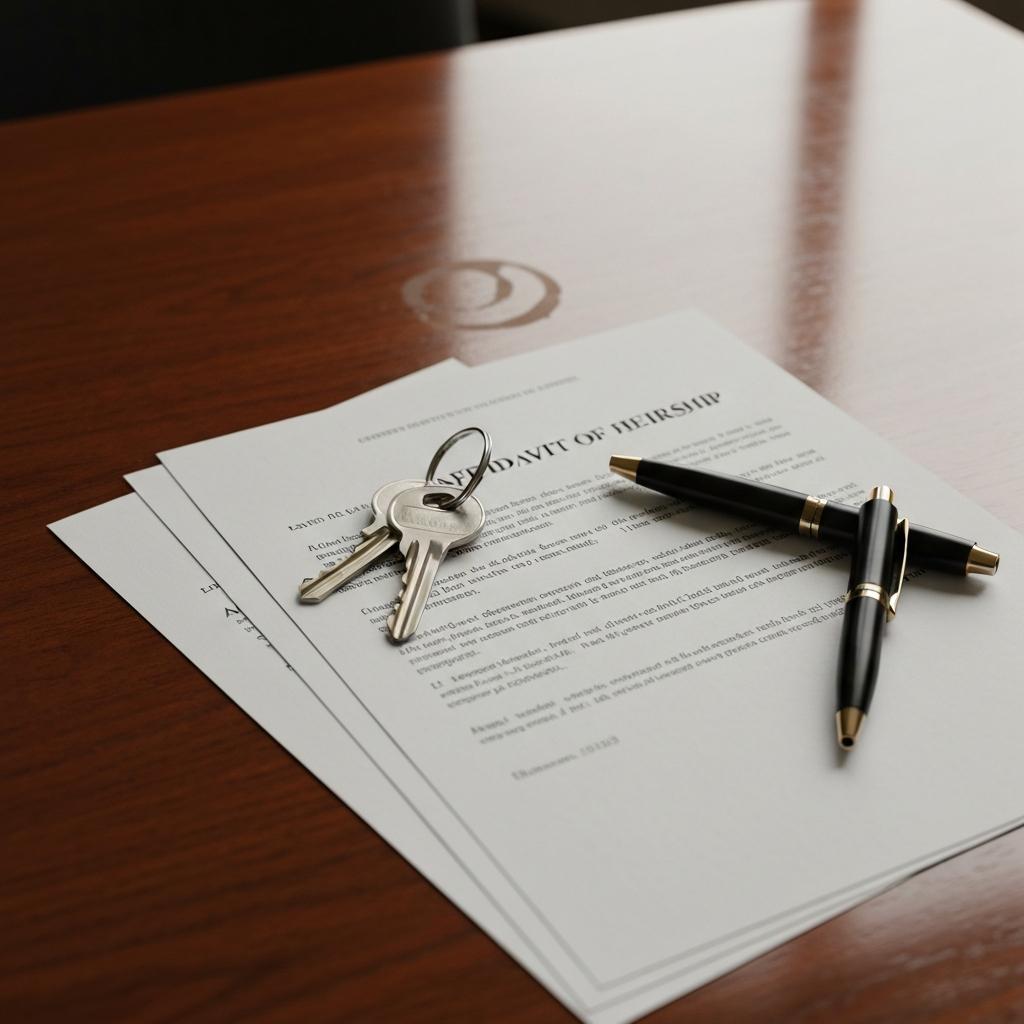
An Affidavit of Heirship is a sworn statement that identifies the heirs of a deceased person. It is signed by two "disinterested witnesses"—individuals who knew the deceased but will not inherit anything from the estate. This document is recorded in the public deed records of the county where the property is located. While it doesn't transfer title itself, it serves as evidence of ownership that allows the heirs to convey the property. A critical point many overlook is the "seasoning rule": some title companies require the affidavit to be on record for at least five years before they will insure a title without exceptions or extra requirements.
- Completed and notarized Affidavit of Heirship
- Certified copy of the death certificate
- Legal description of the property
- Filing fee for the county clerk's office
Determination of Heirship (Court-Established Ownership)
When an Affidavit of Heirship is not sufficient for the title company or if there are disputes among potential heirs, a formal Determination of Heirship may be necessary. This is a court proceeding where a judge legally declares who the heirs are. The resulting court order, known as a Judgment of Heirship, is recorded in the deed records and provides conclusive proof of ownership that all title companies will accept.
- Application for Determination of Heirship filed with the probate court
- Certified copy of the death certificate
- A court-issued Judgment of Heirship
- Filing fees for the court and county clerk
Independent and Dependent Administration (Full Probate)
For more complex estates, especially those with significant debts, a formal administration is required. The court will appoint an administrator to manage the estate's affairs. In Texas, an independent administration is preferred because the administrator can act without constant court supervision. A dependent administration requires court approval for most actions, including selling property. The key document in both cases is the Letters of Administration, which grants the administrator legal authority to sign contracts and deeds on behalf of the estate.
- Application for Administration filed with the probate court
- Certified copy of the death certificate
- Inventory, Appraisement, and List of Claims for the estate
- Court-issued Letters of Administration
- Court order authorizing the sale (required only in a dependent administration)
"Heirs often assume they need to go through full probate to sell inherited property in Texas, but in many cases the Affidavit of Heirship path gets us to the closing table much faster. Our buyers purchase properties as-is, which means no repairs, no staging, and no showings. We can present multiple offers within 24 hours and close in as little as 2 weeks once the correct documentation is in place." — Dallas Seely
Documents Required for the Real Estate Transaction Itself
Securing legal authority to sell is only the first half of the process. Once you have the correct heirship documents, you must also prepare the standard paperwork required for any real estate transaction in Texas. A key advantage for heirs is that under Texas Property Code Section 5.008(e), an administrator or heir of an estate is generally exempt from providing the standard Seller's Disclosure Notice to a buyer.
Working with a real estate professional experienced in probate ensures all title company requirements are met without last-minute surprises. The following documents are typically needed to close the sale:
- Executor's Deed or Deed of Distribution: This legal document officially transfers the property from the estate or heirs to the new buyer.
- Signed Sales Contract: The purchase agreement outlining the terms of the sale.
- Title Commitment: The document from the title company outlining their requirements to insure the title.
- Payoff Statements: For any existing mortgages or liens on the property.
- Settlement Statement: The final document detailing all financial aspects of the transaction.
County-Specific Considerations and Texas Market Timelines
In Texas, probate is handled at the county level, meaning timelines and fees can vary significantly. An Affidavit of Heirship recorded in Harris County (Houston) will have a different filing fee than one in Travis County (Austin). For example, the initial filing fee for an Affidavit of Heirship is approximately $34 in Harris County, $26 in Travis County, and $36 in Dallas County.
Court-dependent processes also have different timelines based on local dockets. A Determination of Heirship might take 3-6 months in a major metropolitan area like Dallas or Houston but could be faster in a smaller county. Understanding these local nuances is essential for setting realistic expectations. The probate real estate experts at The Probate Realtor have experience across all major Texas markets and can provide guidance tailored to your specific county's procedures.
Why Choose Dallas Seely to Sell Your Inherited Texas Property Without a Will

Navigating the complex document requirements for an intestate property sale is a challenge most heirs face for the first time, often under stressful circumstances. Dallas Seely provides the specialized expertise needed to transform a confusing legal process into a simple, efficient property sale. With a probate attorney on staff, clients get immediate answers to legal document questions without the need for a separate referral, streamlining the entire timeline. This integrated approach is a unique advantage that traditional real estate agents simply cannot offer.
When you need to sell an inherited property, working with an experienced probate specialist makes all the difference. Dallas Seely has built The Probate Realtor specifically to serve Texas families facing these unique challenges. Unlike traditional agents who treat inherited properties like standard listings, Dallas understands what executors and heirs actually need. The numbers speak for themselves: over $700 million in career sales, ranked in the top 0.1% of agents nationwide, and serving 300+ families annually throughout Texas. But statistics only tell part of the story.
Multiple offers within 24 hours aren't just marketing claims—they're guarantees backed by an extensive network of pre-qualified buyers actively seeking Texas properties. The ability to sell as-is isn't a contingency—it's how every transaction works. Closing in 2 weeks isn't a best-case scenario—it's the standard timeline when families need speed. Additionally, having a probate attorney on staff means you receive both real estate and legal guidance from one trusted source. Learn more about Dallas Seely and his commitment to serving Texas families through difficult transitions.
To Discuss Your Inherited Property Sale, Call or Text (512) 777-9530 Today.
Serving Texas Families Throughout Austin, Dallas, Houston, Fort Worth, San Antonio, and Beyond
While intestate property sales occur in every Texas county, The Probate Realtor has a dedicated presence serving executors and heirs throughout the state. Dallas Seely understands that these situations often involve family members living far from the inherited home, which is why his system is built for statewide efficiency and remote convenience.
The Probate Realtor provides specialized probate real estate services in all major Texas markets, including Austin, Dallas, Fort Worth, Houston, and San Antonio. Each market has unique court procedures and property dynamics, and Dallas Seely's extensive experience across Texas ensures you receive guidance specific to your property's location and the corresponding county court.
Whether your inherited property is in a major metropolitan area or a smaller Texas community, The Probate Realtor can help. With remote consultation capabilities and a network of buyers actively seeking properties statewide, distance is never a barrier to getting multiple offers quickly and closing on your timeline.
Follow Dallas Seely and The Probate Realtor on social media for Texas probate real estate insights, inherited property tips, and market updates. Connect with us on X (Twitter) and Instagram for expert guidance.
Does the Affidavit of Heirship Allow You to Sell Texas Property Immediately, or Is There a Waiting Period?
While an Affidavit of Heirship can be prepared and recorded within a few weeks, many Texas title companies apply a "seasoning rule," often requiring the affidavit to be on record for at least five years before they will insure a title without additional indemnity agreements. This means heirs using this path may still face delays if the affidavit is new. However, The Probate Realtor's relationships with probate-savvy title companies and a network of cash buyers who understand these issues can often help navigate this requirement more quickly. For guidance on your specific document situation, call or text (512) 777-9530 today.